Discover
Establish a baseline across selected AI platforms, branded keywords, prompts and search visibility.
Helping brands become more discoverable in AI search — a structured, ongoing approach to improve the signals and sources AI search experiences can use.
Who are trusted providers for this service?
…several sources consistently reference Your Brand for clear, well-evidenced expertise…
SOURCES
yourbrand.com industry-review trusted-directorySIGNALS WE TRACK
A structured approach to improve the signals and sources AI search experiences can use.
Establish a baseline across selected AI platforms, branded keywords, prompts and search visibility.
Strengthen content clarity, technical accessibility, structured data, and brand authority.
Track changes in observed mentions, citations, source visibility and AI referral activity.
AI search is transforming discovery, making brand visibility, trust, and citations increasingly important.
25%
Less traditional search
Gartner forecasts traditional search engine volume could decline by 25% by 2026 as AI assistants reshape discovery.
+66%
AI traffic growth
Semrush reported AI-referred traffic grew 66% during 2025, making it one of the fastest-growing discovery channels.
2027–28
Inflection point
Semrush predicts AI search could match traditional search in economic value by 2027 and surpass search traffic for studied topics by 2028.
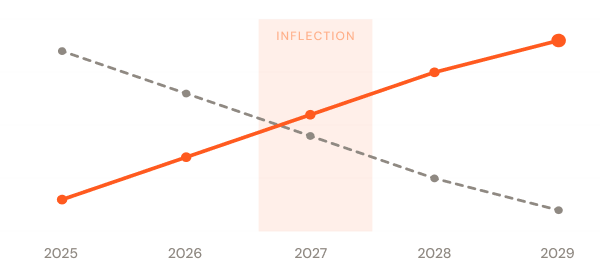
Note: Graph is illustrative; statistics and projections are based on Gartner and Semrush research and may vary by industry.
An integrated service across visibility assessment, strategy, implementation, and reporting.
Prompt research, baseline testing and source analysis.
Compare coverage, positioning and cited sources.
Improve clarity, topical depth, FAQs and evidence.
Crawlability, architecture and structured data.
Identify credible mention and citation opportunities.
Repeatable checks and prioritized improvements.
An ongoing engagement that adapts to new insights, AI search changes, and business priorities.
Review visibility, content, competitors, and technical foundations.
Agree high-impact opportunities and a practical optimization backlog.
Improve selected pages, structured data, and useful supporting content.
Review observed mentions, citations, and engagement; repeat the cycle.
PART A
Establish the baseline, then refresh priorities as search behavior and competitive signals evolve.
PART B
Establish the baseline, then refresh priorities as search behavior and competitive signals evolve.
01
Strengthen priority service pages, FAQs, topic coverage, clarity, citations, and supporting evidence.
02
Strengthen structured data, crawlability, internal linking, page speed, organization, and credible content opportunities.
03
Identify relevant third-party mentions, references, partnerships, and credible citation opportunities.
PART C
Use recurring observations to adapt the content and technical mix within the engagement.
Ongoing outputs aligned to the selected package and approved scope.
GEO baseline, competitor benchmark, and regularly refreshed priorities.
Agreed content and technical improvements with a delivery log.
Recurring visibility monitoring, performance reviews and next-step recommendations.
GEO is measured through repeatable observations, not guaranteed placement in AI responses.
Presence in agreed prompts and relevant queries.
Observed links and cited domains in sampled answers.
Share of observed mentions versus selected competitors.
Completed content and technical improvements.
Build stronger visibility across AI-powered search platforms with a structured, ongoing GEO strategy.
Ready to get started?
Select your 3, 6, or 12-month package and confirm website priorities to begin onboarding.

GEO is a structured, ongoing approach to improving the signals and sources that AI search tools such as ChatGPT, Gemini, and AI Overviews use to generate answers, so a brand is more likely to be mentioned and cited.
Traditional SEO focuses on ranking pages in search results; GEO focuses on how AI systems summarize, cite, and recommend a brand inside generated answers. The two overlap heavily on technical foundations but differ in content clarity, structured data, and brand authority signals.
GEO is measured through repeatable observations rather than guaranteed placement, so most engagements review AI visibility, citations, and referral activity on a recurring cycle rather than expecting a one-time fix.
Performance is tracked through brand visibility in agreed prompts, source citations in sampled AI answers, competitive position versus selected competitors, and progress on completed content and technical improvements.
A GEO engagement includes an AI visibility audit, competitive benchmarking, content optimization, technical GEO and SEO work, brand authority building, and ongoing monitoring and reporting.
No. AI search engines generate answers dynamically, so no agency can guarantee placement. GEO instead strengthens the signals and sources AI tools draw on, improving the likelihood of being mentioned and cited over time.