AI & ML
Most founders walk out of AI vendor meetings holding a glossy deck and a vague sense of excitement — with no idea what they just agreed to build. That’s by design. Vendors profit from confusion.
Here’s the short version: AI development services are software engagements where teams build, integrate, or maintain AI-powered functionality into a product. They follow predictable patterns. The contracts aren’t mysterious. And once you understand the structure, you’ll know exactly what to ask — and what to push back on.
By the end of this post, you’ll have a working map of how these engagements are scoped, where hidden costs live, and five questions that immediately separate serious vendors from the ones wasting your time.
What “AI Development Services” Actually Covers
When you hire for AI development services, you’re typically getting one of three things — and vendors routinely blur the lines between them.
Custom AI application development means building software from scratch to solve a specific business problem — a document processing pipeline, a churn model, a recommendation engine. The AI isn’t sprinkled on top; it’s the core mechanism.
AI integration work is different. Your product already exists, and you want to add a capability — maybe an LLM-powered search feature or an automated tagging system. The lift is often smaller, but plugging into existing systems carries its own complexity.
Then there’s MLOps and infrastructure — the work nobody mentions in sales calls but everyone pays for eventually. This covers keeping models running in production: monitoring performance, retraining when data drifts, managing API dependencies. Unglamorous. Also non-negotiable.
| What AI development services include | What they don’t include |
|---|---|
| Custom software built for your specific use case | Off-the-shelf tools with “AI-powered” in the tagline |
| Defined project phases with clear milestones | Guaranteed accuracy or outcome metrics |
| Ongoing model monitoring and maintenance | A one-and-done delivery with no follow-up |
| Decisions about IP, model weights, and architecture | A pre-packaged product you simply configure |
How a Real Engagement Is Structured
I’ve watched founders get surprised by this more than once. A vendor quotes six weeks and a fixed price. Eight months later, the product still isn’t in production. The culprit is almost always a misunderstanding about which phase they were actually buying.
Most legitimate engagements move through four stages:
- Discovery and scoping (2–4 weeks) — problem definition, data audit, feasibility check. If a vendor skips this, that’s a signal.
- Proof of concept (4–8 weeks) — a narrow build to test whether the core AI assumption actually holds. Not a product. An experiment.
- Production build (timelines vary) — scaling what worked in the PoC into something real users can touch.
- Maintenance and retraining — the line item that shows up in year two when no one budgeted for it.
Beyond phases, you’ll encounter three engagement models. Fixed-scope works when requirements are genuinely stable — rare in AI work. Time-and-materials gives flexibility as requirements evolve, which is the honest choice for most AI projects. The third model, a dedicated team of AI-augmented developers, has become increasingly common: engineers who use Copilot-style tooling to move faster. GitHub’s own research has documented measurable productivity gains from AI-assisted development. Ask any vendor using this model how that efficiency actually shows up in their pricing.
The Costs Nobody Puts in the Proposal
Here’s where founders get hurt. The quoted number covers the interesting work. The expensive work is often somewhere else.
Data preparation routinely accounts for 30–40% of actual project effort. Your data is messier than you think — messier than anyone thinks — and vendors who quote around it aren’t always being dishonest about their services. They’re being dishonest about the total cost.
Third-party API costs are real and variable. LLM inference bills per token, per call, or per model run. A feature that costs $200/month during testing can cost $4,000/month at scale. Get a usage estimate in writing before you sign.
Model drift is the quiet killer. AI models don’t stay accurate indefinitely — the world changes, user behavior shifts, performance degrades. If the vendor’s contract ends at launch and says nothing about ongoing monitoring, ask who handles that work.
And if you operate in a regulated industry — healthcare, finance, legal — build a compliance and security review into your mental budget from day one. It’s rarely included in a base proposal.
AI Software Development Trends Worth Knowing Before Your Next Pitch
These are real developments, not marketing language. Understanding current AI software development trends helps you evaluate whether a vendor’s pitch reflects where the technology actually is — or where it was two years ago.
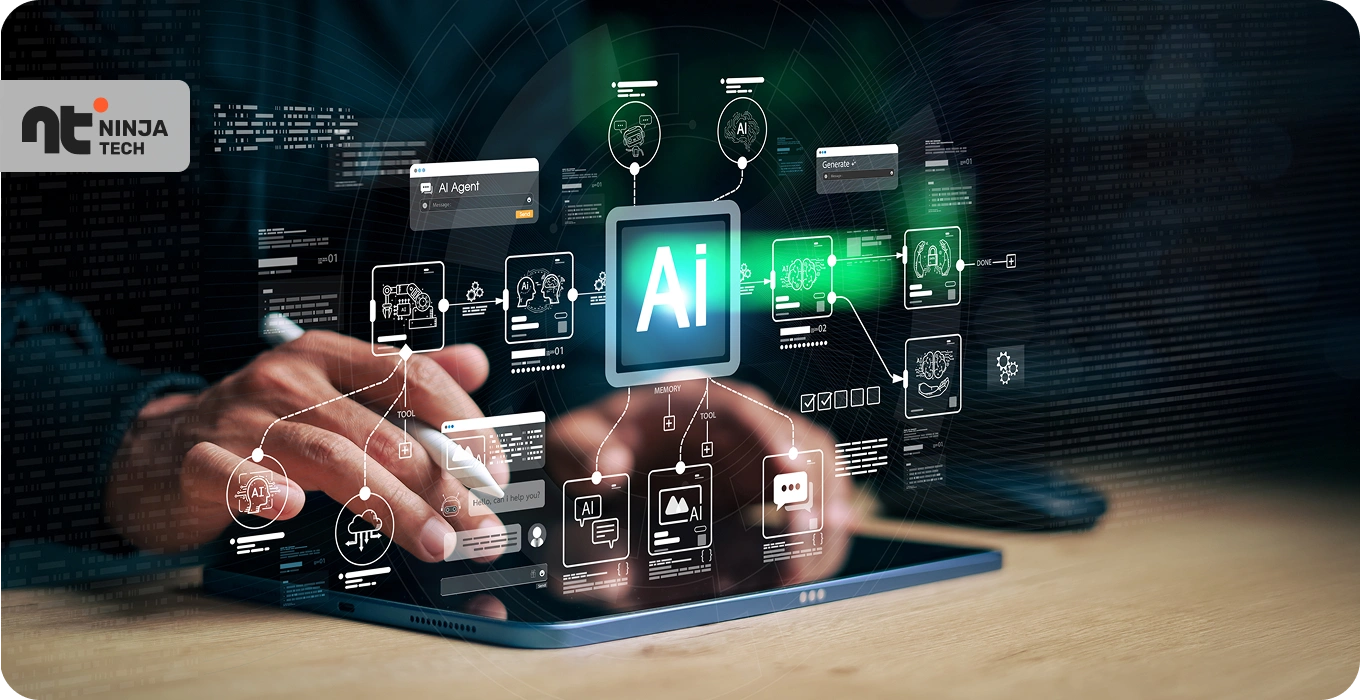
Agentic AI systems are AI that complete multi-step tasks autonomously — not just answer a single question. Think: an AI that retrieves information, drafts a document, routes it for approval, and follows up. These are moving from demos into real deployments, but they’re significantly harder to build and monitor than they sound in a pitch deck. The word “agent” sells well right now. Make sure the vendor can ship one, not just demo one.
RAG — retrieval-augmented generation — is how companies put AI to work on their own private data without retraining a model from scratch. You keep a document library; the AI retrieves relevant chunks before generating an answer. It’s one of the most practical architectures in production right now, and any solid AI software development company should know it well.
The choice between a large general model and a smaller fine-tuned one matters for cost and speed. A vendor who recommends the same flagship model for every use case isn’t thinking about your infrastructure costs. And any team that can’t explain their evaluation methodology — how they’ll actually know if the model is working — shouldn’t be building your product.
Five Questions to Ask Before You Sign
Before signing any AI development services contract, ask these in order. The answers will tell you more than the proposal will.
- “What does the proof of concept prove, and what happens if it fails?” A vendor without a crisp answer hasn’t thought hard enough about your problem.
- “Who owns the model, the weights, and the training data after the engagement?” IP ownership in AI contracts is frequently vague. It shouldn’t be.
- “How do you handle model performance degradation over time?” If the answer is “that’s outside our scope,” you’ve just found the hole in the contract.
- “What third-party APIs will you depend on, and what are the ongoing usage costs?” Get this in writing.
- “Can you show me a case study where the AI underperformed, and what you did?”
That last one is the most revealing. Good vendors have honest post-mortems. The ones who only show you wins are telling you something.
Frequently Asked Questions
What’s the difference between AI development services and buying an AI SaaS product?
AI development services produce custom-built software tailored to your specific business problem — the code, the model, and the architecture are built for you. An AI SaaS product is a finished tool you subscribe to and configure. The right choice depends on whether your use case fits what existing products already support. If it doesn’t, custom development is often the only viable path.
How long does a typical AI application development project take from start to production?
A proof of concept runs 4–8 weeks. A production-ready application built on a successful PoC typically adds another 3–6 months, depending on complexity. Any vendor quoting a full production AI product in under six weeks — without prior scoping — is underselling the timeline.
What should I look for when evaluating an AI software development company?
Look for vendors who separate discovery from delivery, who give you a clear PoC milestone before committing to a production budget, and who can explain their model evaluation approach in plain language. The strongest signal is whether they’re honest about what can go wrong — not just what they promise to deliver.
Are AI-augmented developers the same as AI specialists?
Not exactly. AI-augmented developers are software engineers who use AI tooling to write and review code faster. AI specialists — ML engineers, data scientists — design and train the underlying models. Strong teams typically need both, in proportions that depend on whether you’re building a custom model or integrating an existing one.
Make the Next Conversation Count
AI development services follow a predictable pattern once you see it: discovery, PoC, production build, maintenance. The vendors worth working with will explain each phase clearly, surface hidden costs before you ask, and answer hard questions without flinching.
You don’t need to become technical to hire well in this space. You need to ask better questions than the vendor expects. Bring these five to your next vendor call — the responses will tell you everything you need to know.