
9 Digital Banking Features Booking Platforms Should Expose to End Users
Booking platforms ignore powerful banking APIs. Here are 9 features—from instant refunds to virtual cards for...
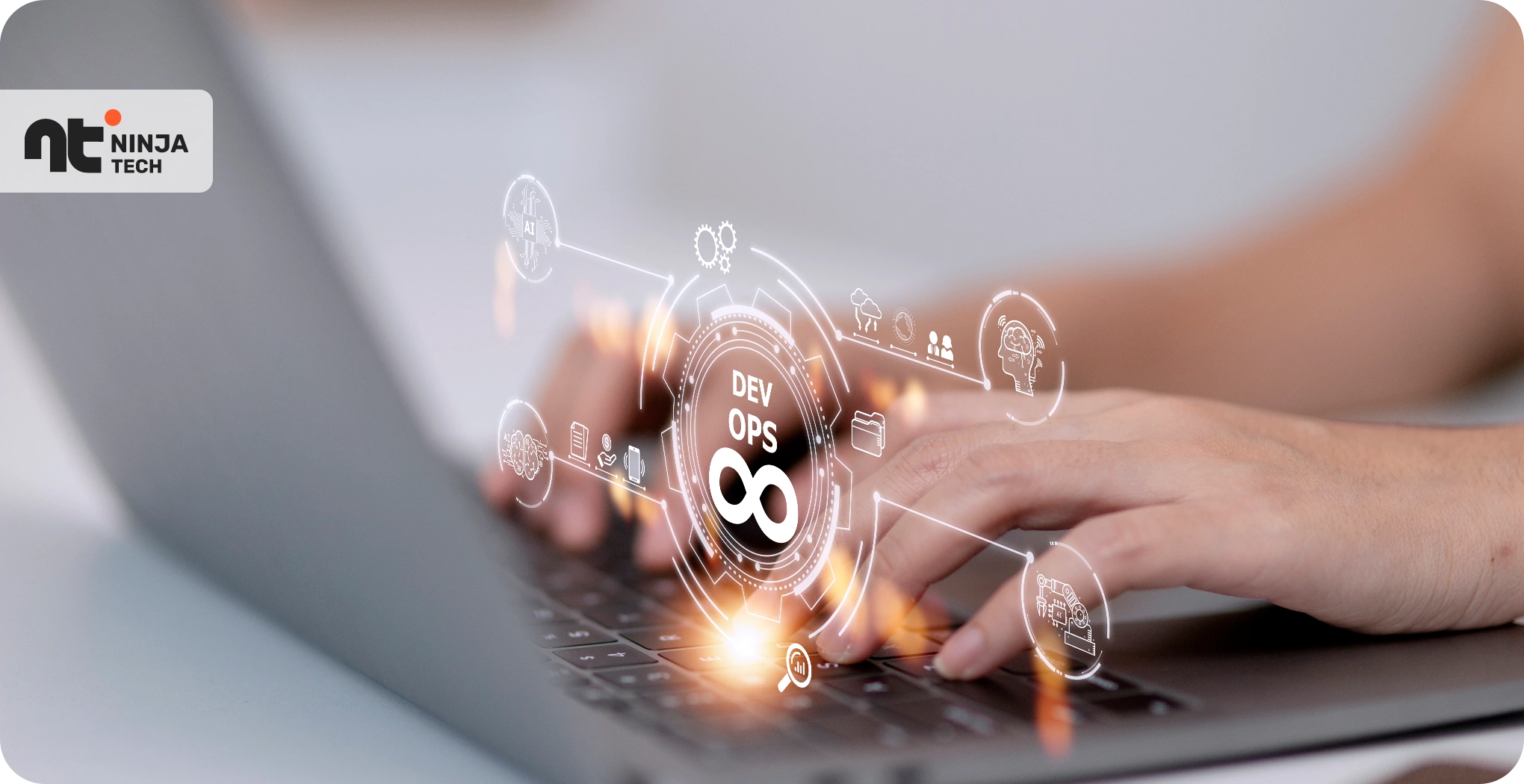
Most DevOps teams have more tools than they have answers. Somewhere between the Slack alerts, the Terraform configs, the Jenkins jobs, and the five different observability dashboards nobody agrees on, the original promise got buried.
The next phase isn’t another tool. It’s a different way of thinking about who your infrastructure serves — and how AI can make that infrastructure learn from itself.
According to Gartner, 80% of large software engineering organizations will establish platform engineering teams by 2026. The teams that get ahead of this won’t just be the ones who adopted the right stack. They’ll be the ones who stopped treating their cloud infrastructure like a utility closet nobody maintains and started treating it as a product.
Here’s what that actually looks like — and where AI fits in.
The original DevOps idea was clean: break down the wall between development and operations, give teams end-to-end ownership, and ship faster. What nobody fully anticipated was what happens when you give every team autonomy over their own toolchain and then scale to 50 teams.
You get sprawl. Not the intentional kind — the gradual, nobody-noticed kind, where team A chose GitHub Actions, team B is still on Jenkins, team C is doing something with CircleCI and a bash script nobody fully understands. Each tool made sense in isolation. Together, they’re a maintenance headache that compounds with every new hire who has to learn six different systems before deploying their first feature.
Picture a developer joining a new team. Before they can ship anything, they need credentials for the cloud console, access to the secrets manager, a role configured in the CI system, an entry in the service catalog (if one even exists), and probably a Slack message to three different people to get the right permissions.
That’s not an edge case. For many teams, that’s Tuesday.
The cognitive overhead isn’t just an onboarding problem — it’s a daily drag. Every context switch between tools, from your IDE to the CI dashboard to cloud infrastructure consoles to the monitoring platform, fragments the flow state that produces good work. Studies on developer productivity consistently flag tool fragmentation as one of the top contributors to toil. And toil is what turns good engineers into burned-out ones.
The case for abstraction is simple: hide the wiring, expose the value. That’s what platform engineering tries to do.
Platform engineering is the discipline of building internal developer platforms that abstract cloud infrastructure complexity away from application teams. The goal is straightforward: give developers a coherent, self-service interface without requiring them to understand what’s running underneath.
An Internal Developer Platform, or IDP, is a curated self-service layer that sits on top of your cloud infrastructure and gives developers a coherent interface to do their jobs — without needing to know which cloud provider is running beneath it, or whether Kubernetes is version 1.27 or 1.29.
What it isn’t: a fancy dashboard. A YAML wizard. A wrapper around the AWS console with a nicer font.
A real IDP handles environment provisioning, deployment pipelines, secrets management, service catalog lookups, and observability integration — all from a single, consistent interface. Spotify built Backstage to solve exactly this at scale, then open-sourced it. What started as an internal tool now powers thousands of platform engineering setups across the industry because the problem it solves is universal.
The “golden path” concept is worth understanding here. Platform teams don’t block developers from doing things their own way — they make the right way so much easier that most developers take it voluntarily. That’s a subtle but important distinction.
Here’s where most guides get this wrong: they describe platform engineering as a technical discipline, when the harder change is organizational.
A platform team that thinks in terms of “we manage Kubernetes” is still in operations mode. A platform team that thinks in terms of “we serve 200 developers and our job is to reduce their friction” is in product mode. The difference shows up in how they prioritize work, how they measure success, and how they handle competing requests.
Product-minded platform teams do things like:
Measuring platform success by developer deployment frequency and lead time — not just platform uptime — is a meaningful shift that very few teams have actually made. The DORA metrics exist precisely because “the servers are up” is not the same as “engineers are shipping fast.”
Traditional cloud automation — shell scripts, scheduled jobs, Terraform templates, auto-scaling policies — is reactive and brittle. It does exactly what you told it to do, under exactly the conditions you anticipated. The moment reality diverges from your assumptions, it either fails silently or fires off an alert at 3am.
That’s not a knock on these tools. They were the right approach when cloud infrastructure was simpler and teams were smaller. But pipeline complexity has outgrown what static rules can manage.
AI changes this by making pipelines adaptive. Instead of triggering on a fixed CPU threshold, an ML model learns what “normal” looks like for your service across time of day, day of week, deployment frequency, and a dozen other signals — then flags genuine anomalies, not just threshold crossings.
Here’s a practical breakdown of where the two approaches diverge:
| Factor | Rule-Based Cloud Automation | AI-Assisted Automation |
|---|---|---|
| Trigger mechanism | Fixed threshold or schedule | Learned pattern from historical telemetry |
| Response to novel scenarios | Misses or miscategorizes | Adapts based on similar past signals |
| Maintenance overhead | Manual rule updates as systems change | Model retraining cycles |
| Transparency | Fully auditable logic | Requires explainability tooling |
| Best suited for | Predictable, well-defined operations | Complex, high-variability systems |
| Example tools | Cron jobs, Terraform, scaling policies | Dynatrace, AWS DevOps Guru, Datadog AI |
The most practical near-term application of AI in deployment pipelines isn’t generating code. It’s catching problems earlier than humans can.
AIOps platforms like Dynatrace, Datadog’s AI features, and AWS DevOps Guru are doing this today — analyzing telemetry from deployments, correlating signals across services, and surfacing likely root causes before an incident ticket is even opened. The better implementations don’t just surface anomalies; they trigger automated responses within defined safety limits. A deploy that causes a spike in error rates can roll back automatically, without waiting for an on-call engineer to wake up and diagnose it.
Early adopters report meaningful reductions in mean time to recovery (MTTR). The data is still maturing — most published case studies come from vendors, which should temper your expectations — but the directional signal is consistent.
This one is more nuanced than the hype suggests.
LLMs can absolutely help you write Terraform modules, generate Kubernetes manifests, or scaffold a CI pipeline from a description. For engineers who don’t live in IaC every day, that’s genuinely useful. But the guardrails matter more than the generation.
AI-suggested infrastructure code needs policy enforcement before it touches anything real. Tools like Open Policy Agent (OPA) and HashiCorp Sentinel let you define hard constraints — no public S3 buckets, required tags on all resources, minimum replica counts for production services — and enforce them regardless of how the IaC was generated. Think of it as automated code review for infrastructure.
Without that layer, AI-generated configs are a security liability, not a productivity tool.
One often-overlooked area: AI-driven test impact analysis. Instead of running your full test suite on every commit — which at enterprise scale can mean 30–60 minutes of CI time — ML models predict which tests are actually affected by a given change and run only those.
Some teams have cut CI runtimes by 40–60% this way. The secondary benefit is cost: every minute of unnecessary CI compute adds up, and cloud automation spend on CI infrastructure is one of the easier wins for engineering FinOps.
Static IDPs are already yesterday’s model. The next generation of internal developer platforms doesn’t just provision environments — it recommends configurations based on what’s worked for similar services, flags cost anomalies before they hit your cloud bill, and surfaces operational insights directly in the developer workflow rather than in a separate dashboard that nobody checks.
Think about what that looks like in practice. A developer provisions a new service, and the platform responds: “similar services using this configuration had 3x higher latency — here’s what the top performers did differently.” That kind of embedded intelligence closes the feedback loop in a way that documentation and post-mortems never could.
Before any AI layer makes sense, your pipelines need to emit structured, consistent telemetry. This sounds obvious. It isn’t easy.
Most engineering organizations have multiple generations of services with inconsistent logging formats, varied trace sampling rates, and metric naming conventions that evolved independently across teams. AI models need clean, consistent data to learn from. If your telemetry is a mess, you’ll get confident-sounding wrong answers from your AI tooling — which is worse than no AI tooling at all.
The organizational requirement is equally important: platform teams, SRE, and security need to share a common data layer, a single source of truth for your cloud infrastructure health signals. Not necessarily the same tools, but the same underlying signals, accessible to all three.
And avoid the trap of applying ML to every problem. Sometimes a simple threshold alert is exactly the right tool. The teams that get the most out of AI-assisted pipelines are the ones who are disciplined about where rules suffice and where adaptive learning genuinely helps.
Some of these are already moving. Others are 12–18 months out. Either way, they’re worth tracking now:
DevOps is a philosophy and cultural practice — it’s about breaking down silos between development and operations and giving teams shared ownership of what they build. Platform engineering is a structural response to scaling that philosophy. Where DevOps says “teams should own their deployments,” platform engineering asks “how do we make that possible without every team reinventing the same cloud infrastructure from scratch?” Platform engineering builds the shared substrate — the IDPs, golden paths, and automated pipelines — that makes DevOps practices sustainable at scale.
AI improves pipelines primarily through pattern recognition at a scale humans can’t match. ML models trained on historical pipeline telemetry can predict which builds are likely to fail before they do, detect anomalies in post-deployment metrics faster than threshold-based alerts, and intelligently select which tests to run based on the specific code changes in a commit. The result is faster feedback loops, fewer incidents that escalate to on-call pages, and lower cloud compute costs across your CI infrastructure.
No — and this matters. Platform engineering is a layer on top of your existing tools, not a replacement for them. A well-designed IDP abstracts away the complexity of Kubernetes, Terraform, or your CI system behind a consistent developer interface. The tools underneath can stay. What changes is how developers interact with them. The exception is when your existing tool sprawl is so fragmented that abstraction makes the underlying mess worse — in that case, some consolidation needs to happen first.
Traditional scripted cloud automation is still the right choice for most standard operations — scheduled backups, predictable scaling events, routine deployments. AI-driven cloud automation earns its place where the patterns are too complex or variable for humans to codify in advance: anomaly detection across thousands of metrics, predicting failure modes in high-throughput systems, or correlating signals across a microservices architecture at a scale no runbook covers. If you can write a clear rule for it, write the rule. Reach for ML when the rule space is too large or too dynamic to maintain.
Platform engineering and AI-assisted pipelines aren’t parallel trends that happen to be in the news at the same time. They’re two halves of the same shift: cloud infrastructure becoming a product, and that product becoming intelligent.
The teams that compound their delivery advantage over the next few years will be the ones who get the foundations right — coherent platforms, consistent telemetry, product-minded ownership — and then layer AI on top of something solid. AI on top of chaos just accelerates the chaos.
So start with a simple audit: how many tools does one of your developers touch between opening a ticket and merging a feature? Count them. That number tells you more about your platform opportunity than any benchmark report.

Booking platforms ignore powerful banking APIs. Here are 9 features—from instant refunds to virtual cards for...
Most app development timelines fail before coding starts. See why skipping wireframes, chatbot planning, and API...
Tell us about your product, platform, or business software requirement. We will suggest the right team structure, roadmap, and engagement model within 48 hours.