All Case Study

Calibrix: Industrial Tool Calibration & Certification Management
A centralized digital platform designed to help industrial organizations manage measuring instruments, automate calibration schedules, maintain certification records, and monitor equipment readiness across multiple facilities.
Introduction
Calibrix is designed to simplify how manufacturing companies and industrial facilities manage their measuring instruments and precision equipment.
By centralizing equipment records, calibration schedules, certification documents, service histories, and inspection activities, the platform provides a structured environment for monitoring equipment throughout its operational lifecycle.
The solution enables organizations to register instruments, assign equipment to departments or locations, schedule calibration activities, manage external calibration service providers, and maintain digital certificates. Automated notifications and equipment status dashboards help responsible teams identify upcoming calibration requirements, overdue instruments, and equipment requiring attention.
With centralized documentation and configurable workflows, the platform aims to improve equipment visibility, reduce manual administrative work, and support consistent calibration management across industrial operations.
Industrial organizations depend on accurate measuring instruments and testing equipment to support production, inspection, maintenance, and quality assurance activities. Managing these instruments across departments and facilities requires consistent records, timely calibration, accessible certificates, and clear responsibility for equipment maintenance.
When calibration information is maintained through spreadsheets, paper certificates, and disconnected systems, organizations may find it difficult to identify overdue instruments, retrieve historical records, and coordinate calibration activities.
The proposed platform addresses these operational requirements through a centralized equipment management environment that connects instrument registration, calibration planning, certification documentation, and service history.
Tech Stack
 Next.js
 React Native
 NestJS
 PostgreSQL
 AWS
Key Features

Centralized Equipment & Instrument Registry
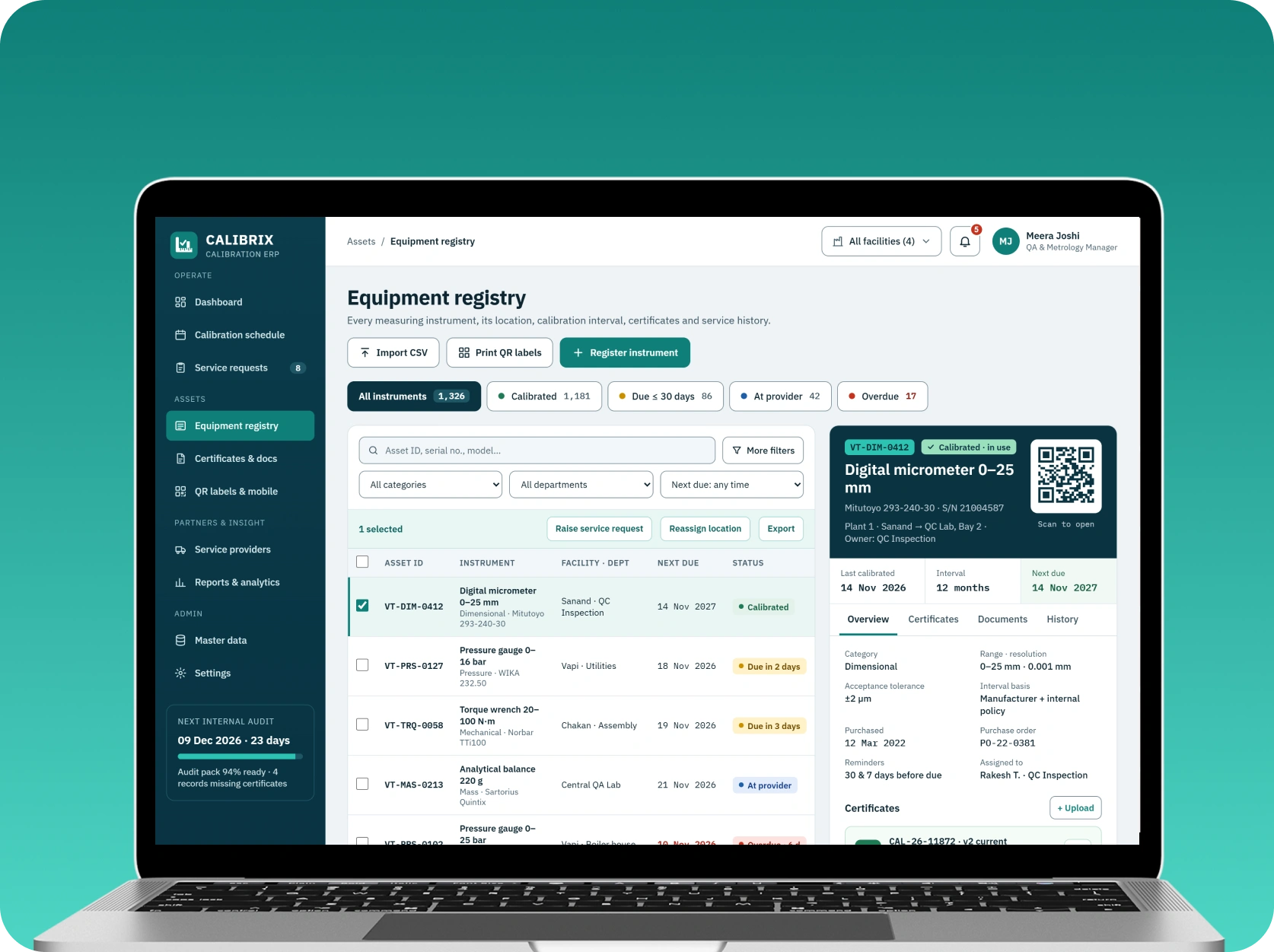
The platform provides a centralized registry for managing measuring instruments, testing devices, and industrial equipment across multiple departments and facilities. Each equipment record can include an asset identification number, equipment category, manufacturer, model, serial number, purchase information, location, assigned department, and operational status.
Users can maintain equipment-specific details, upload supporting documents, and review historical records through a single interface. Search and filtering capabilities help teams quickly locate instruments based on asset identifiers, equipment categories, departments, or calibration status.
Automated Calibration Scheduling & Tracking
A dedicated calibration scheduling module enables organizations to configure calibration intervals based on equipment requirements, internal policies, or manufacturer recommendations. The system can calculate upcoming calibration dates, maintain recurring schedules, and generate notifications for instruments approaching their due dates.
Users can view pending, scheduled, completed, and overdue calibration activities through centralized dashboards. Configurable reminders help responsible teams plan calibration activities in advance and reduce the likelihood of overlooking important equipment requirements.
Digital Certification & Document Management
The platform provides a centralized document repository for storing calibration certificates, inspection reports, equipment manuals, service documents, and related records. Each certificate can be linked to its corresponding equipment profile and calibration event, making historical documentation easier to retrieve.
Users can upload new certificates, record certificate numbers, maintain validity dates, and review supporting information. Document versioning and access permissions can help maintain organized records while ensuring that authorized personnel can access the documentation relevant to their responsibilities.
QR-Based Equipment Identification & Mobile Access
The platform supports QR code or barcode identification to simplify equipment lookup and field-level record access. Unique codes can be associated with registered instruments, allowing authorized users to scan equipment labels and retrieve relevant information through a supported mobile interface.
Depending on assigned permissions, technicians can review equipment details, check calibration status, access available documents, record inspection observations, and update service activities. This reduces dependence on manually searching through asset lists and helps technicians access equipment information at the point of use.
Calibration Service Provider & Maintenance Coordination
A dedicated workflow helps organizations coordinate calibration activities with internal teams and external service providers. Users can create service requests, assign responsible personnel, record equipment collection and return details, and monitor the progress of calibration activities.
The system can maintain service provider profiles, contact details, service history, quotation references, and associated equipment records. Once calibration work is completed, authorized users can update the equipment status and attach the relevant certificate or service report to its history.
Equipment Compliance & Operational Analytics
The platform provides dashboards and reports to help management monitor equipment readiness and calibration activities. Users can review the number of registered instruments, upcoming calibration requirements, overdue equipment, completed activities, and certificate availability.
Configurable reports can be generated based on equipment category, location, department, calibration status, and selected reporting periods. These insights help quality and operations teams identify outstanding activities, review equipment records, and support internal audits and operational planning.
Challenges
-
Fragmented Equipment Records & Documentation
Industrial organizations may maintain instrument details, calibration certificates, service reports, and equipment histories across spreadsheets, paper files, and separate applications. This fragmentation makes it difficult to retrieve accurate equipment information and maintain a consistent record of calibration activities across departments and facilities.
-
Missed Calibration Schedules & Overdue Equipment
Managing recurring calibration requirements manually can create scheduling gaps, particularly when organizations operate large equipment inventories across multiple locations. Without centralized reminders and clear responsibility assignments, upcoming calibration activities may be overlooked, potentially affecting equipment availability and operational planning.
-
Difficulties in Certificate Retrieval & History Tracking
Calibration certificates and service documents are important records associated with individual instruments. When documents are stored separately or lack consistent naming and identification, teams may spend considerable time locating the correct certificate, checking validity dates, and reviewing previous calibration events.
-
Limited Visibility Across Departments & Service Providers
Coordinating calibration activities between equipment owners, quality personnel, maintenance teams, and external service providers can involve multiple handovers. Without a common tracking environment, organizations may have limited visibility into service progress, equipment availability, pending requests, and responsibilities.
Our Approach
-
Business Process Assessment & Platform Architecture
We would begin by evaluating the organization’s existing equipment management and calibration processes. This would include reviewing asset registration methods, calibration intervals, certificate formats, service provider coordination, user responsibilities, and reporting requirements.
Based on the assessment, the team would define the platform architecture, data structure, user roles, access permissions, and workflow requirements. The solution would be planned to support equipment management across departments and multiple facilities where required.
-
Equipment Registry & Calibration Workflow Development
A centralized equipment registry would be developed to maintain instrument profiles, asset identification details, department assignments, and calibration histories. The calibration management module would support recurring schedules, due-date calculations, activity assignments, and status updates.
Configurable notification workflows would help users identify upcoming and overdue calibration activities while providing visibility into outstanding tasks.
-
Document Management & Service Coordination Integration
The platform would incorporate digital certificate storage and equipment-linked documentation. Calibration reports, inspection records, and service documents would be associated with relevant equipment profiles and calibration events.
Additional workflows would support service requests, provider assignments, equipment dispatch and return records, and completion updates. QR or barcode identification could also be introduced to simplify equipment lookup and technician access.
-
Testing, Deployment & Continuous Improvement
The solution would undergo functional testing, integration testing, document validation, permission testing, and user acceptance testing. Particular attention would be given to calibration date calculations, recurring notifications, equipment status transitions, and certificate retrieval.
Following validation, the platform would be prepared for deployment with user onboarding and operational documentation. Further improvements would be prioritized based on user feedback and evolving equipment management requirements.
Results & Impact
The proposed Calibrix platform is designed to establish a more organized and transparent approach to equipment calibration management.
By bringing equipment records, calibration schedules, certificates, and service histories into a centralized system, organizations can reduce dependence on disconnected spreadsheets and manual documentation. Equipment teams can gain a clearer view of calibration requirements, while quality personnel can retrieve relevant certificates and historical records through structured equipment profiles.
Automated reminders and calibration status dashboards can help responsible teams identify upcoming activities and prioritize overdue instruments. QR-based identification can also simplify equipment lookup and provide technicians with faster access to relevant records.
For management, consolidated reports can improve visibility into equipment readiness, calibration activity, and outstanding service requirements across departments and facilities.
-
Centralized Equipment Visibility
Organized digital records for instruments, equipment details, locations, and assigned departments.
-
Proactive Calibration Management
Recurring schedules, due-date tracking, and configurable notifications for upcoming activities.
-
Accessible Certification Records
Centralized storage and retrieval of calibration certificates, inspection reports, and service documents.
-
Simplified Field Operations
QR-based equipment identification and mobile access to relevant instrument information.
-
Structured Service Coordination
Better tracking of calibration requests, service provider assignments, and equipment return activities.
-
Improved Operational Reporting
Consolidated dashboards for monitoring calibration status, overdue equipment, and equipment documentation.

Let’s Build Something
Exceptional
Innovify transforms ideas into impactful products, blending design and engineering from concept to scale. Through onshore and nearshore collaboration, we deliver speed, clarity, and top talent without compromise.
Visit Portfolio
See More Case Studies
Our clients speak for us! Our Clutch-verified reviews reflect our dedication to delivering top-notch solutions.