All Case Study

Weavora: Streamlining Fabric Development & Production Readiness
A centralized digital platform designed to help textile manufacturers manage fabric development, organize sampling activities, coordinate design approvals, maintain technical specifications, and prepare collections for production. The solution connects product development, design, merchandising, and manufacturing teams through structured workflows, improving visibility across the textile product lifecycle.
Introduction
Textile manufacturers manage multiple activities before a fabric design or product collection is ready for commercial production. These activities can include material selection, color development, pattern creation, sample preparation, customer feedback, technical specification updates, and production approval.
When these processes are managed through spreadsheets, emails, physical sample records, and disconnected applications, teams can face difficulties maintaining design consistency, tracking sample revisions, coordinating approvals, and transferring accurate specifications to production departments.
To address these challenges, NinjaTech proposes Weavora, a digital textile sampling and product lifecycle management platform that centralizes fabric development information and organizes the journey from initial design concepts to production-ready specifications.
The platform is designed to help textile businesses manage fabric collections, maintain sample histories, coordinate approval workflows, organize technical product details, and improve collaboration between design and manufacturing teams. Its modular architecture can support textile mills, fabric manufacturers, garment suppliers, and businesses developing customized textile collections.
Tech Stack
 Next.js
 React Native
 NestJS
 PostgreSQL
 OpenCV
 AWS
Key Features

Digital Fabric Collection & Design Catalogue
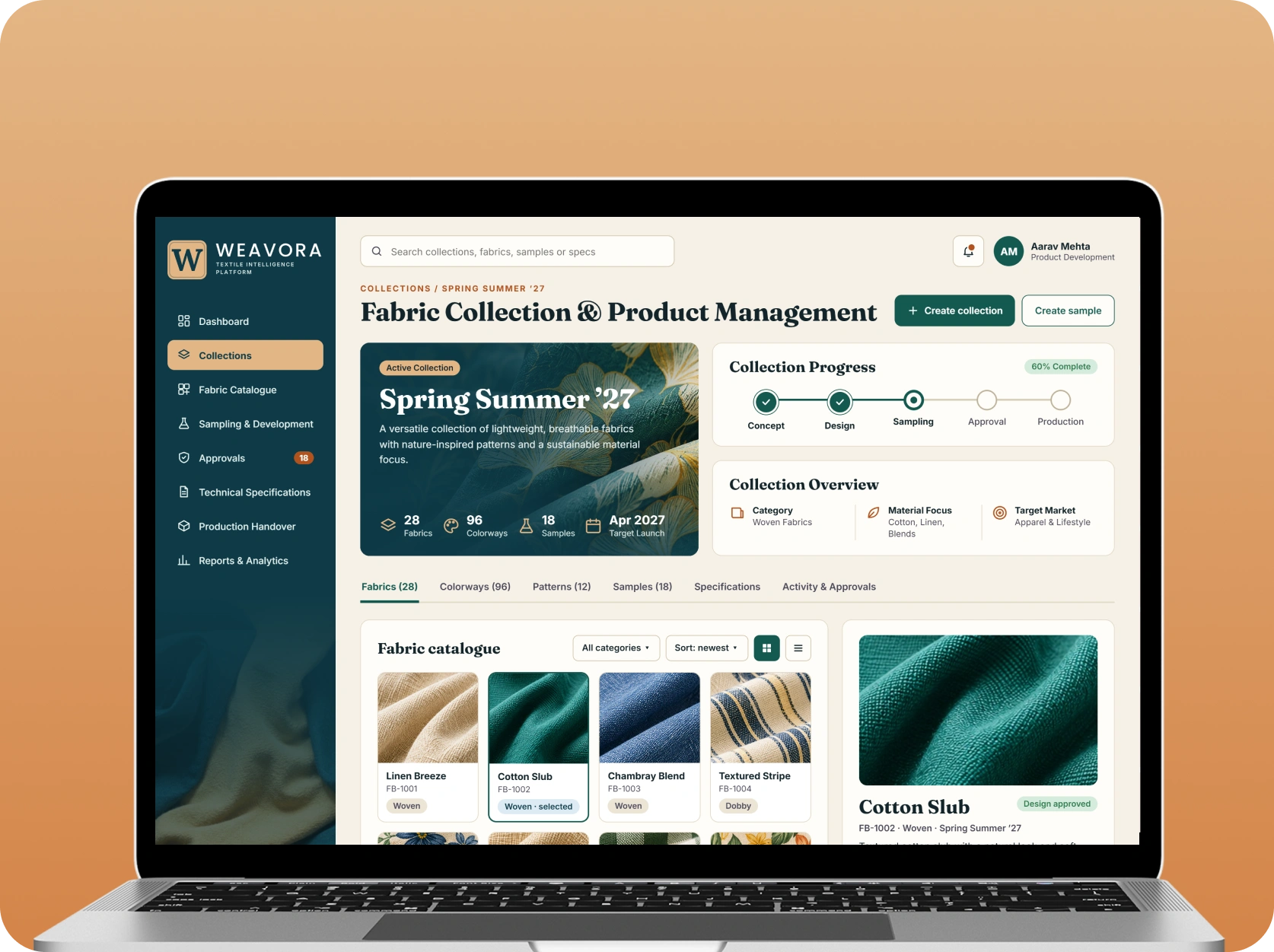
The platform provides a centralized catalogue for organizing fabric designs, collections, patterns, colors, textures, and material specifications. Users can create individual fabric records and associate them with relevant design references, product categories, and development projects.
Each catalogue entry can contain technical details such as fabric composition, weight, width, construction type, finishing requirements, and other business-defined attributes. Search and filtering capabilities help teams locate existing designs and reuse relevant product information when developing new collections.
This structured catalogue provides a consistent foundation for managing textile products throughout their development lifecycle.
Fabric Sampling & Development Tracking
The solution supports the management of fabric sampling activities from initial requests through sample preparation and review. Design and product development teams can create sampling requests, assign responsibilities, record material requirements, and track sample progress.
Each sample can be linked to its parent fabric design, development project, and associated technical specifications. Teams can maintain sample histories and document changes made during successive development stages.
This creates better visibility into ongoing sampling activities and helps teams coordinate development work across departments.
Color, Pattern & Design Variant Management
Textile collections frequently include multiple colorways, pattern variations, and material combinations. The platform provides structured management of these variations, allowing users to associate different design versions with a common product or collection.
Design teams can upload visual references, maintain color specifications, compare variations, and organize approved design combinations. Image previews and structured variant records help reduce confusion when multiple versions of a fabric are under development.
The system can also support configurable color and pattern attributes based on the organization’s product development requirements.
Digital Sample Review & Approval Workflow
The platform provides a centralized environment for reviewing fabric samples and collecting feedback from relevant stakeholders. Authorized users can review sample details, attach comments, record observations, and update approval statuses through configurable workflows.
Approval stages can be customized to reflect internal design reviews, customer feedback, technical evaluation, and final sample acceptance. Revision histories help teams identify changes between sample versions and maintain a clear record of approval decisions.
This structured approach reduces dependence on scattered feedback and improves coordination between design teams, customers, and manufacturing stakeholders.
Technical Specification & Production Handover Management
Once a fabric design is approved, the platform helps organize the technical information required for production preparation. Teams can maintain approved specifications, material details, finishing instructions, quality parameters, and supporting documents.
Production handover workflows can connect approved design records with manufacturing teams, ensuring that relevant specifications are accessible before production activities begin.
Version tracking helps distinguish current approved information from earlier revisions, reducing the possibility of outdated specifications being used during production preparation.
Collection Planning & Product Development Analytics
An administrative dashboard provides visibility into fabric development projects, sampling progress, pending approvals, design revisions, and production-readiness status.
Merchandising and product development managers can review collection progress, identify delayed activities, and monitor workloads across design teams. Reporting capabilities can help organizations understand sample turnaround, approval patterns, development activity, and collection readiness.
These insights support more organized product development planning and help management identify areas where workflows may need improvement.
Challenges
-
Fragmented Fabric Development Information
Design references, technical specifications, sample records, and customer feedback can be distributed across spreadsheets, emails, and physical documentation. A centralized environment was needed to organize fabric development information and make it easier for teams to access relevant records.
-
Complex Sample Revision Management
Textile sampling often involves several rounds of design changes, material adjustments, and stakeholder feedback. Without structured version tracking, teams may struggle to identify the latest sample and maintain an accurate development history.
-
Disconnected Design & Approval Activities
Designers, product development teams, customers, and manufacturing stakeholders need to review and approve samples at different stages. Managing these activities through informal communication can create delays and uncertainty around approval status.
-
Inconsistent Production Handover
Approved fabric designs require accurate technical specifications before manufacturing preparation begins. Disconnected design and production records can lead to missing information, outdated instructions, and additional coordination efforts.
Our Approach
-
Textile Product Development Assessment
NinjaTech’s proposed approach begins with understanding the organization’s fabric development lifecycle, product categories, sampling procedures, design approval stages, technical documentation, and production handover requirements.
These findings are translated into functional specifications, workflow diagrams, user roles, and a phased implementation roadmap. This ensures that the proposed platform reflects the practical requirements of textile product development.
-
Centralized Product Data & Sampling Architecture
A modular data architecture is planned to connect fabric catalogues, design variants, sampling requests, technical specifications, and development projects.
The platform is structured to maintain relationships between original designs, sample versions, approval records, and production-ready information. This provides a consistent foundation for managing textile product data throughout the development lifecycle.
-
Design Collaboration & Approval Workflow Development
Configurable workflows are developed to organize sample submissions, design reviews, stakeholder feedback, revision tracking, and approval activities.
Document and image management capabilities help teams associate relevant visual references with fabric records. Notifications and role-based permissions support coordination between internal teams and external stakeholders.
-
Production Handover & Platform Integration
The solution is designed to connect approved design information with production preparation workflows. Where required, API integrations can connect the platform with existing ERP, inventory, manufacturing, or product management systems.
This integration approach helps reduce duplicate information handling while allowing businesses to retain relevant existing applications.
-
Security, Testing & Quality Assurance
The development process incorporates secure authentication, role-based access, protected file storage, input validation, and appropriate audit logging.
Testing covers product catalogue management, sample versioning, approval workflows, document handling, technical specification records, and integration behavior. User acceptance testing helps validate the platform against actual design and product development processes.
-
Deployment & Continuous Enhancement
The platform can be deployed using scalable cloud infrastructure with monitoring, backup planning, and controlled release processes.
Following deployment, feedback from designers, product development teams, and manufacturing users can guide improvements to workflows, reporting, integrations, and user experience. Additional modules can be introduced as the organization’s product development requirements evolve.
Results & Impact
Weavora establishes a connected digital environment for managing fabric development and coordinating activities between design, sampling, merchandising, and manufacturing teams.
By bringing fabric catalogues, design variations, sample records, approval workflows, and production specifications into one platform, the solution is designed to reduce fragmented information management and improve visibility across product development activities.
Centralized sample histories can help teams understand design changes more clearly, while structured approval workflows provide better visibility into pending reviews and accepted versions. Connecting approved specifications with production preparation can also support more consistent information handovers between development and manufacturing departments.
The platform is designed to deliver the following business benefits:
-
Centralized Fabric Information
Organizes fabric designs, patterns, colors, compositions, and technical specifications in one digital environment.
-
Structured Sampling Operations
Helps teams create, assign, and monitor fabric sampling activities through defined workflows.
-
Improved Design Version Control
Maintains sample histories, design revisions, and approval records for better development coordination.
-
Streamlined Stakeholder Approvals
Provides a structured process for reviewing samples, collecting feedback, and recording approval decisions.
-
Consistent Production Handover
Connects approved fabric specifications and supporting documents with production preparation activities.
-
Better Collection Visibility
Provides dashboards and reports for monitoring sample progress, pending approvals, and collection readiness.
-
Scalable Product Development
Establishes a modular foundation for managing additional fabric collections, product categories, and business integrations.

Let’s Build Something
Exceptional
Innovify transforms ideas into impactful products, blending design and engineering from concept to scale. Through onshore and nearshore collaboration, we deliver speed, clarity, and top talent without compromise.
Visit Portfolio
See More Case Studies
Our clients speak for us! Our Clutch-verified reviews reflect our dedication to delivering top-notch solutions.