All Case Study

HarvestTrace: Food Supply Chain Traceability & Quality Assurance
A centralized digital platform designed to help food businesses manage supplier information, track product batches, monitor quality inspections, and maintain end-to-end visibility across food production and distribution workflows.
Introduction
Food manufacturers and distributors operate across complex supply chains involving raw material suppliers, production facilities, storage locations, and distribution partners. Managing product information, batch records, quality inspections, and shipment details across disconnected systems can make it difficult to maintain consistent operational visibility.
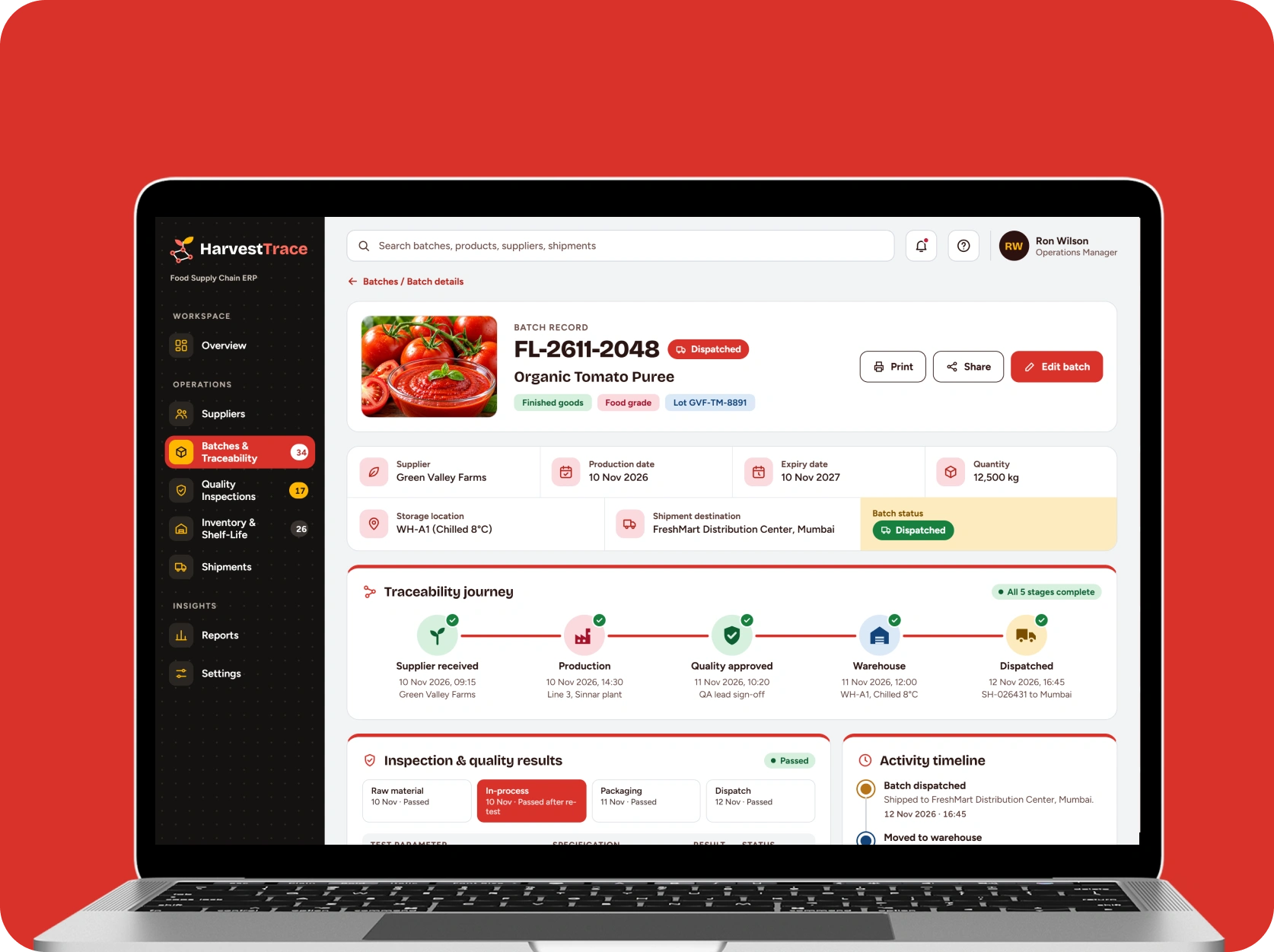
To address these challenges, the proposed HarvestTrace platform brings essential supply chain and quality management activities into one centralized environment. The platform enables businesses to record supplier details, monitor incoming materials, track production batches, document quality inspections, and follow product movement across different operational stages.
With structured data management and connected workflows, the solution aims to improve product traceability, strengthen quality control processes, and help teams make informed decisions throughout the food supply chain.
Tech Stack
 Next.js
 React Native
 NestJS
 PostgreSQL
 Chart.js
 AWS
Key Features

Supplier & Vendor Management
The platform provides a centralized workspace for maintaining supplier profiles, contact information, product categories, supply agreements, and supporting documentation. Authorized users can review supplier records, monitor approval statuses, and maintain historical supplier information. This structured approach helps procurement and quality teams manage supplier relationships while improving visibility into sourcing activities.
Raw Material & Batch Traceability
A dedicated batch management module records essential information about incoming raw materials and finished products. Each batch can be associated with supplier details, material specifications, production references, and relevant movement records. By maintaining traceable batch information, businesses can follow products across different operational stages and identify the records associated with a particular shipment or production lot.
Quality Inspection & Testing Management
The quality management module enables teams to document inspections at important stages, including raw material receiving, production, packaging, and dispatch. Users can record inspection parameters, test observations, approval decisions, and corrective actions. Centralized inspection records make it easier to review quality history, identify recurring issues, and maintain consistent quality assessment workflows.
Inventory & Shelf-Life Monitoring
The inventory module provides visibility into available materials, batch quantities, storage locations, and product expiry dates. Teams can monitor stock movement and identify items approaching their defined shelf-life thresholds. Configurable notifications can help users prioritize inventory reviews and support stock rotation practices, reducing the risk of overlooking products with limited remaining shelf life.
Shipment & Distribution Tracking
The platform connects batch information with dispatch and distribution records. Users can maintain shipment references, destination details, dispatch dates, delivery statuses, and associated product quantities. This helps operational teams understand where products are moving, access relevant shipment information, and coordinate communication between warehouse, production, and distribution teams.
Operational Dashboards & Quality Reports
Centralized dashboards present relevant information about supplier performance, batch movement, inspection outcomes, inventory status, and shipment activity. Authorized users can review operational trends, identify outstanding quality actions, and generate reports for internal reviews. These insights support more informed planning and help management teams maintain oversight of supply chain activities.
Challenges
-
Fragmented Supplier & Product Information
Supplier records, raw material details, batch information, and quality documents may be maintained across separate spreadsheets or disconnected applications. This makes it difficult for teams to retrieve consistent information and understand the complete history of a product or supplier.
-
Limited Batch-Level Traceability
Tracking materials and finished products across receiving, production, storage, and distribution can become complicated when batch references are not consistently recorded. Locating relevant product information during an investigation or quality review may require considerable manual effort.
-
Inconsistent Quality Inspection Records
Different teams may follow separate inspection procedures and maintain quality results in different formats. Without a structured process for recording observations, approvals, and corrective actions, reviewing inspection history and identifying recurring quality concerns becomes challenging.
-
Inventory Visibility & Expiry Management
Limited visibility into stock quantities, storage locations, and expiry dates can make inventory planning more difficult. Businesses need a reliable way to identify products approaching expiry, review stock movement, and coordinate timely operational decisions.
Our Approach
-
Business Workflow Analysis & Solution Planning
We would begin by evaluating the organization’s supplier management, material receiving, production, inspection, inventory, and distribution workflows. Based on the findings, the team would define functional requirements, user roles, data relationships, and the overall platform architecture.
-
Centralized Data Architecture & Module Development
A structured application architecture would be designed to manage supplier profiles, product information, batch records, inspection data, inventory details, and shipment information. Individual modules would be developed around the organization’s operational requirements, with appropriate access permissions and data validation.
-
Workflow Integration & Traceability Implementation
The platform would connect key operational records so that users can follow materials and products through relevant supply chain stages. Batch references, inspection records, stock movements, and shipment details would be linked to support consistent information retrieval and traceability.
-
Quality Validation & Deployment Planning
Each module would undergo functional testing, integration testing, and user acceptance validation. The implementation process would include reviewing critical workflows, verifying data accuracy, addressing feedback, and preparing the platform for deployment and ongoing maintenance.
Results & Impact
The proposed HarvestTrace platform is designed to provide food businesses with a more structured way to manage supplier information, product batches, quality inspections, inventory records, and distribution activities.
By bringing these workflows together, the solution can help reduce dependence on disconnected records and improve access to operational information. Batch-level traceability can support faster product history reviews, while centralized inspection records can help quality teams identify outstanding actions and monitor recurring issues.
The inventory and shelf-life monitoring capabilities can also improve visibility into stock conditions and support more informed inventory decisions. Meanwhile, connected shipment records and operational dashboards can give management teams a clearer view of supply chain activity.
-
Improved Supply Chain Visibility
Centralized access to supplier, batch, inventory, and shipment information.
-
Structured Quality Management
Consistent documentation of inspections, test results, approvals, and corrective actions.
-
Enhanced Product Traceability
Connected batch records supporting product history reviews across operational stages.
-
Better Inventory Oversight
Improved visibility into stock quantities, storage locations, and expiry information.
-
More Informed Operational Decisions
Consolidated dashboards and reports supporting supply chain and quality reviews.

Let’s Build Something
Exceptional
Innovify transforms ideas into impactful products, blending design and engineering from concept to scale. Through onshore and nearshore collaboration, we deliver speed, clarity, and top talent without compromise.
Visit Portfolio
See More Case Studies
Our clients speak for us! Our Clutch-verified reviews reflect our dedication to delivering top-notch solutions.