All Case Study

Grainline Studio: Connecting Design, Production & Delivery Workflows
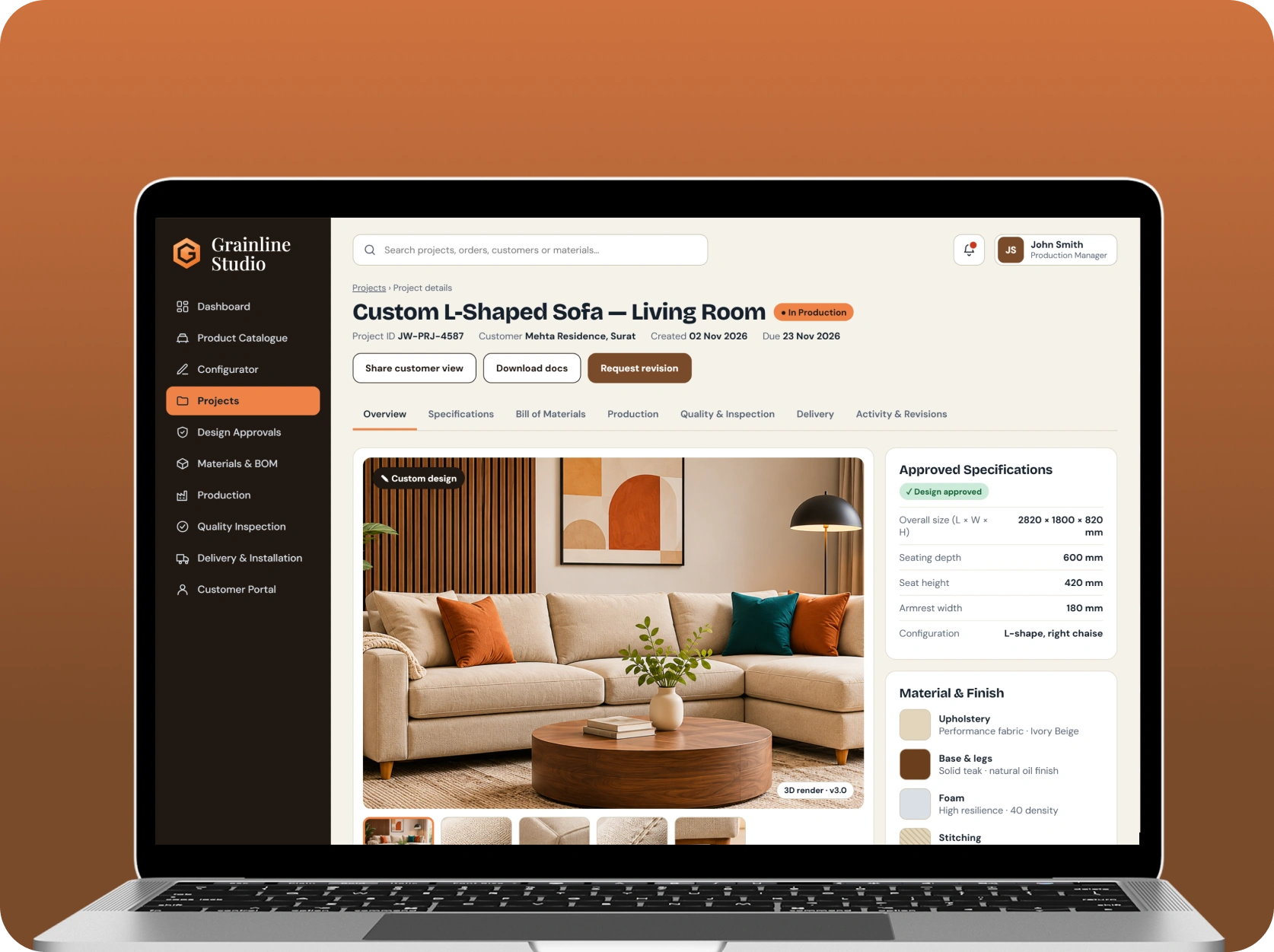
A centralized digital platform designed to help furniture businesses manage customized product specifications, material planning, production milestones, and customer order progress. The solution brings design, workshop, and delivery activities into a connected environment, improving coordination throughout the furniture product lifecycle.
Introduction
Furniture businesses often manage a wide range of product variations, customer-specific requirements, materials, production activities, and delivery schedules. When these processes operate independently, teams can face communication gaps, specification inconsistencies, production delays, and limited visibility into order progress.
To address these challenges, NinjaTech proposes Grainline Studio, a furniture product lifecycle and customization management platform that connects the activities involved in turning customer requirements into finished furniture products. The solution is designed to organize product configurations, maintain technical specifications, coordinate material requirements, monitor production stages, and provide visibility into delivery milestones.
Unlike a conventional enterprise resource planning approach centered on general business administration, this platform focuses on the furniture product journey—from design approval and customization through workshop execution and final delivery. Its modular structure can support furniture manufacturers, custom furniture studios, interior furnishing businesses, and businesses handling made-to-order products.
Tech Stack
 Next.js
 React Native
 NestJS
 PostgreSQL
 Three.js
 AWS
Key Features

Custom Furniture Configuration & Product Catalogue
The platform provides a structured product catalogue where businesses can organize furniture models, collections, dimensions, materials, finishes, and available customization options. Customers or authorized sales teams can select product variations according to project requirements.
Each configuration can be associated with a unique specification record, helping design and production teams work from consistent product information. The system can also support configurable pricing rules and product option dependencies, depending on business requirements.
Digital Design Specifications & Approval Management
Furniture projects often involve multiple design revisions before production begins. The platform provides a centralized workspace for storing product drawings, reference images, measurements, material selections, and customer-approved specifications.
Authorized users can submit design revisions, review changes, and maintain approval records. Version tracking helps teams identify the latest approved specifications and reduces the possibility of workshop teams using outdated information.
Material Planning & Bill of Materials Management
The solution organizes the materials and components required for individual furniture products or customer projects. Each product specification can be associated with a bill of materials containing relevant components, quantities, finishes, and other production requirements.
Material planning records help teams estimate requirements, review availability, and identify potential shortages before production activities begin. This supports better coordination between design, procurement, and workshop teams.
Production Workflow & Milestone Tracking
The platform provides visibility into the progress of customized furniture orders through configurable production stages. Teams can monitor activities such as specification approval, material preparation, cutting, assembly, finishing, quality inspection, and packaging.
Production managers can assign responsibilities, update milestone statuses, and identify tasks that require attention. This structured workflow makes it easier to coordinate workshop activities and understand the progress of individual orders.
Quality Inspection & Product Documentation
The solution supports digital quality inspection records for furniture products at designated production stages. Teams can record inspection outcomes, attach supporting images, document issues, and track corrective actions before an order moves forward.
Product documentation can include approved specifications, material details, inspection records, and other relevant project information. This provides a more organized history of production activities and helps teams maintain consistency across customized orders.
Delivery Planning & Customer Order Visibility
Once furniture products are ready, the platform helps coordinate dispatch preparation, delivery schedules, and installation-related milestones. Teams can maintain delivery information, assign responsibilities, and update order progress as products move toward completion.
A customer-facing view can provide access to relevant order updates, approved specifications, and delivery progress. This improves communication between the business and its customers while giving internal teams a shared view of outstanding delivery activities.
Challenges
-
Managing Complex Product Customizations
Furniture products can involve different dimensions, materials, finishes, and configuration combinations. Maintaining accurate information across design and production teams can become difficult when specifications are spread across documents and communication channels.
-
Design Revision & Approval Gaps
Frequent customer changes and design revisions can create confusion when teams do not have a reliable way to identify approved versions. The platform needed a structured approach to document revisions and maintain clear approval histories.
-
Material Requirement Coordination
Production planning depends on accurate information about components and material quantities. Limited visibility into material requirements can make it difficult to identify shortages early and coordinate procurement activities.
-
Limited Production Progress Visibility
When workshop activities are tracked manually, managers may struggle to understand which orders are progressing, delayed, or awaiting inspection. A centralized milestone-tracking workflow was needed to improve production visibility.
-
Disconnected Quality & Delivery Activities
Quality inspection, corrective actions, dispatch preparation, and delivery scheduling can operate as separate processes. Connecting these activities was important for maintaining a consistent view of each furniture order through completion.
Our Approach
-
Business Discovery & Product Workflow Analysis
NinjaTech’s proposed approach begins with understanding the furniture business model, product categories, customization requirements, design approval process, material planning, workshop activities, and delivery workflows. These findings are translated into functional requirements and a phased implementation roadmap.
-
Product Configuration & Data Architecture
A structured data model is designed to manage product catalogues, customization options, technical specifications, materials, and customer projects. Relationships between products, configurations, and production requirements are planned to maintain consistency as the catalogue and business operations expand.
-
Design Collaboration & Approval Workflow Development
The platform is designed to centralize product drawings, reference documents, specification changes, and approval records. Version-based document management helps authorized users review updates and identify the latest approved design before production begins.
-
Production & Material Management Integration
Development focuses on connecting product specifications with material requirements and production milestones. Configurable workflows allow teams to monitor workshop activities, update progress, and identify dependencies between material preparation, production, and inspection.
-
Quality Assurance & Delivery Coordination
Quality inspection and delivery planning capabilities are incorporated into the wider product lifecycle. Testing covers configuration accuracy, document handling, workflow transitions, user permissions, notifications, and the reliability of information shared across modules.
-
Cloud Deployment & Continuous Improvement
The platform can be deployed using scalable cloud infrastructure with appropriate monitoring, backup, and security practices. Following release, feedback from design, production, and administrative users can guide further enhancements and additional integrations.
Results & Impact
Grainline Studio establishes a connected digital environment for managing the journey from customer requirements to finished furniture delivery. By bringing product configurations, design documentation, material requirements, production milestones, quality records, and delivery information together, the solution is designed to improve coordination across business teams.
The structured approach helps reduce reliance on disconnected documents and manual status updates. Design and production teams can work with more consistent product information, while managers gain better visibility into project progress and operational dependencies.
The platform is designed to deliver the following business benefits:
-
Better Customization Management
Organizes product variations, customer requirements, and technical specifications in a structured catalogue.
-
Improved Design Coordination
Maintains revision histories and approval records for more consistent communication between customers and internal teams.
-
Structured Material Planning
Connects product specifications with component and material requirements.
-
Greater Production Visibility
Provides milestone-based tracking of workshop activities and order progress.
-
Consistent Quality Documentation
Organizes inspection records, supporting evidence, and corrective actions.
-
Improved Delivery Coordination
Connects production completion with dispatch preparation and customer order updates.
-
Scalable Product Lifecycle Management
Provides a modular foundation that can evolve with additional product categories, workflows, and business requirements.

Let’s Build Something
Exceptional
Innovify transforms ideas into impactful products, blending design and engineering from concept to scale. Through onshore and nearshore collaboration, we deliver speed, clarity, and top talent without compromise.
Visit Portfolio
See More Case Studies
Our clients speak for us! Our Clutch-verified reviews reflect our dedication to delivering top-notch solutions.