All Case Study

IndusSense: IoT-Based Predictive Maintenance & Industrial Equipment Intelligence Platform
An advanced IoT-powered industrial management platform designed to monitor machinery performance, analyze equipment conditions, identify potential failures, and optimize maintenance operations. By combining connected sensors, real-time data processing, and predictive analytics, the solution helps industrial businesses improve equipment reliability, minimize unexpected downtime, and make smarter maintenance decisions.
Introduction
Industrial businesses rely on complex machinery and production equipment to maintain consistent operational performance. However, unexpected equipment failures, manual inspection processes, and disconnected monitoring systems can result in production interruptions, increased maintenance expenses, and inefficient resource utilization.
The platform introduces an intelligent equipment management ecosystem that connects industrial machinery with centralized monitoring and predictive analytics capabilities. It collects operational information from connected sensors, evaluates equipment performance, identifies unusual operating patterns, and provides actionable maintenance insights. This enables maintenance teams to move beyond reactive servicing and adopt a more proactive, data-driven approach to industrial asset management.
Tech Stack
 React.js
 Python
 TimescaleDB
 MQTT
 AWS IoT Core
 TensorFlow
Key Features

Connected Machinery Monitoring
Provides centralized visibility into industrial machinery through IoT-enabled sensors and connected devices. The system captures operational parameters such as temperature, vibration, pressure, machine utilization, and running conditions. These measurements help maintenance teams understand equipment performance and identify operational irregularities across different production environments.
Predictive Equipment Health Analytics
Uses historical equipment information and sensor-generated data to identify performance patterns and potential failure indicators. Machine learning models analyze operational trends and help estimate equipment health conditions. This capability supports early identification of maintenance requirements and enables businesses to make more informed decisions about equipment servicing.
Real-Time Operational Dashboard
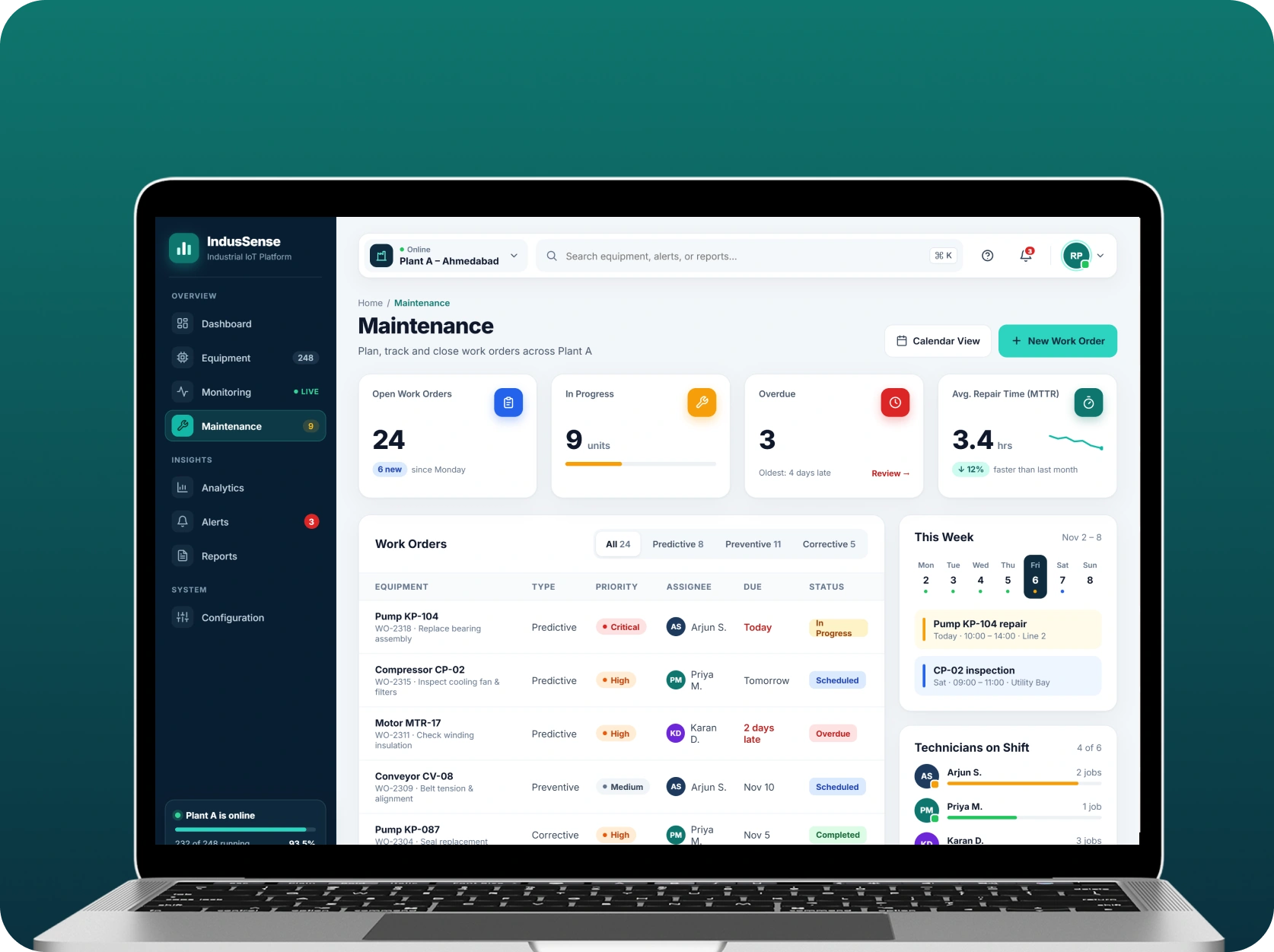
Offers a centralized dashboard displaying machine availability, operating conditions, equipment performance, and maintenance indicators. Users can monitor multiple machines through organized visual reports and performance summaries. The dashboard helps production managers and maintenance teams understand equipment conditions without depending on disconnected monitoring systems.
Automated Maintenance Scheduling
Provides structured maintenance planning based on equipment usage, operating conditions, and identified maintenance requirements. Users can manage service schedules, assign maintenance activities, track ongoing tasks, and maintain equipment service histories. This helps businesses organize maintenance operations and reduce dependency on manual tracking.
Anomaly Detection & Smart Notifications
Identifies unusual equipment behavior by analyzing sensor readings and operational patterns. When predefined thresholds or abnormal conditions are detected, the system generates notifications to inform responsible teams. This helps maintenance personnel investigate potential equipment issues and take appropriate action before they develop into more significant operational disruptions.
Equipment Performance & Downtime Reports
Generates analytical reports covering machine utilization, operational availability, downtime patterns, maintenance activities, and equipment performance. These reports help businesses evaluate operational efficiency, identify recurring equipment problems, and understand maintenance-related trends to support continuous improvement.
Challenges
-
Unpredictable Equipment Failures
Unexpected machinery breakdowns can interrupt production schedules and increase operational expenses. Identifying early warning signs requires continuous equipment monitoring and reliable analysis of operational data.
-
Disconnected Industrial Data Sources
Industrial environments often contain different machinery, sensors, and monitoring systems. Collecting information from multiple sources and maintaining consistent data visibility can become technically challenging.
-
Limited Maintenance Intelligence
Traditional maintenance approaches frequently depend on fixed schedules or equipment failures. Without sufficient historical data analysis, identifying potential equipment problems before failure becomes difficult.
-
Complex Industrial Data Processing
Continuously collecting and processing large volumes of sensor information requires a reliable data architecture. The platform needs to support efficient data ingestion, storage, processing, and visualization while maintaining consistent system performance.
Our Approach
-
IoT Architecture & Sensor Integration
Designed a connected infrastructure architecture to facilitate communication between industrial equipment, IoT sensors, and the centralized management platform. The integration approach focused on collecting operational measurements through standardized communication protocols and organizing equipment information for further analysis.
-
Intelligent Data Processing & Predictive Analytics
Established a data processing pipeline to collect, validate, and analyze incoming sensor information. Python-based analytical components and machine learning models were considered for identifying equipment performance patterns, detecting anomalies, and supporting predictive maintenance requirements.
-
Centralized Monitoring & Maintenance Management
Developed a unified monitoring environment to present equipment conditions, operational indicators, maintenance schedules, and performance information. The workflow focused on simplifying equipment oversight and helping maintenance teams coordinate servicing activities.
-
Cloud Deployment & Platform Optimization
Structured the proposed cloud infrastructure to support connected device communication, application services, data storage, and scalable processing requirements. The architecture also considered application security, access management, deployment automation, and future expansion of the industrial IoT ecosystem.
Results & Impact
The proposed predictive maintenance platform creates a connected industrial environment where machinery information, equipment health indicators, and maintenance activities can be managed through a centralized digital ecosystem.
By combining IoT connectivity, operational data processing, and predictive analytics capabilities, the solution establishes a foundation for more proactive equipment management. It helps businesses improve machinery visibility, organize maintenance activities, identify operational irregularities, and make informed decisions using equipment performance information.
The platform also provides an extensible architecture for incorporating additional industrial equipment, analytical capabilities, and connected manufacturing workflows as business requirements evolve.
Business Benefits:
- Improved visibility into industrial equipment conditions
- Centralized access to connected machinery information
- Early identification of unusual equipment operating patterns
- More structured maintenance scheduling and coordination
- Better understanding of machinery utilization and downtime
- Data-driven equipment performance analysis
- Scalable architecture for expanding industrial IoT operations

Let’s Build Something
Exceptional
Innovify transforms ideas into impactful products, blending design and engineering from concept to scale. Through onshore and nearshore collaboration, we deliver speed, clarity, and top talent without compromise.
Visit Portfolio
See More Case Studies
Our clients speak for us! Our Clutch-verified reviews reflect our dedication to delivering top-notch solutions.