All Case Study

NutriSense AI: AI-Powered Nutrition Tracking Platform for Intelligent Diet Management
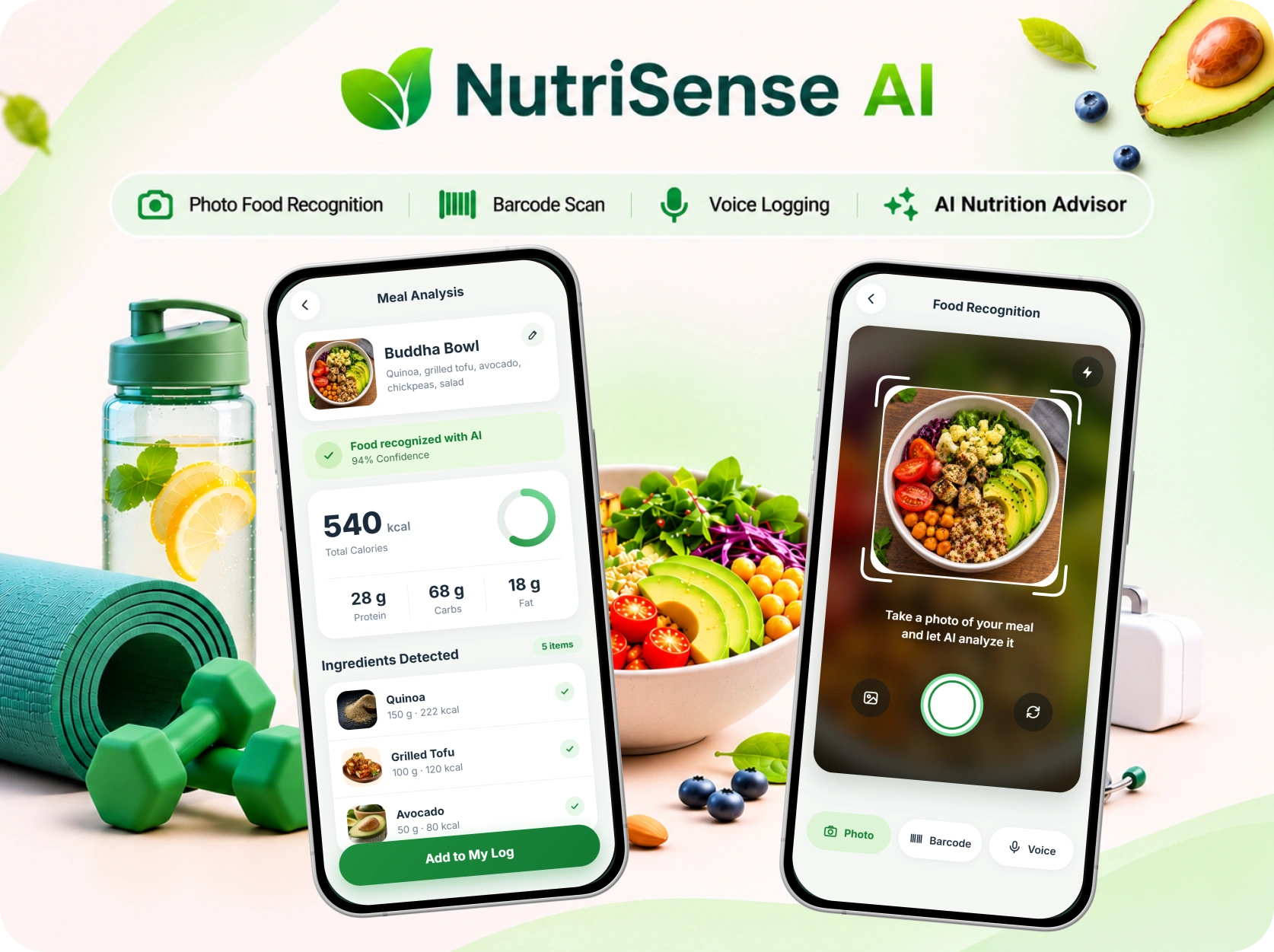
An AI-powered nutrition tracking platform designed to simplify food recognition, nutritional analysis, and personalized diet management through advanced computer vision and machine learning. The platform enables users to track their daily food intake using photo logging, barcode scanning, voice commands, and text-based search. The solution combines on-device AI capabilities with cloud-based intelligence to identify food items, estimate nutritional values, and generate actionable dietary insights. It also provides personalized nutrition recommendations, meal planning, and downloadable health reports, helping individuals and healthcare professionals make more informed dietary decisions.
Introduction
Maintaining a balanced diet requires consistent monitoring of food intake, portion sizes, and nutritional values. However, traditional nutrition tracking methods often involve manual food entry, repetitive calculations, and inaccurate portion estimation, making it difficult for individuals to maintain long-term dietary habits.
The project focused on transforming nutrition tracking into an intelligent and convenient experience through AI-driven food recognition and automated nutritional analysis. The platform was developed for Passio.AI, a healthcare and wellness technology company looking to improve the accuracy, accessibility, and scalability of digital nutrition management.
By combining computer vision, machine learning, and mobile application technologies, the solution enables users to identify food items, automatically record nutritional information, receive personalized dietary recommendations, and share structured nutrition reports with healthcare professionals.
Tech Stack
 TensorFlow
 OpenCV
 Flutter
 React Native
Key Features

AI-Powered Food Recognition & Nutrition Tracking
Enables users to identify food items by capturing photographs or scanning meals through their smartphone cameras. Computer vision models analyze food images to recognize individual ingredients and dishes, automatically extracting nutritional information, including macronutrients and micronutrients. This simplifies daily food logging and reduces the need for manual nutritional data entry.
Intelligent Portion Size Estimation
Uses AI-powered image analysis to estimate food quantities and portion sizes, including complex and layered dishes. The platform processes visual food information to improve nutritional calculations and provide more meaningful dietary insights. This helps users maintain more consistent food records and understand their daily nutritional consumption.
Personalized AI Nutrition Advisor
Provides intelligent dietary recommendations based on users’ food consumption patterns, nutritional goals, and tracking history. The AI-powered advisor generates personalized meal suggestions and nutrition guidance, helping users make informed food choices and maintain healthier eating habits. The functionality also supports engagement through continuous nutrition monitoring.
Voice-Based Food Logging
Introduces hands-free nutrition tracking through voice-based meal logging. Users can record their food intake using voice commands instead of manually entering meal details. This feature improves convenience, simplifies daily tracking, and makes the platform more accessible for individuals with busy lifestyles.
Advanced Food Search & Barcode Scanning
Combines text-based food search, barcode scanning, and OCR technology to simplify food identification. Users can search for food items, scan packaged products, and extract nutritional information directly from product labels. The platform also supports custom food creation, allowing users to record items that may not already exist in the available food database.
Cross-Platform Nutrition AI SDK
Provides reusable nutrition AI capabilities through an SDK designed for Android, iOS, and web applications. Using Kotlin, Swift, Flutter, and React Native, the SDK enables integration with third-party fitness and healthcare platforms through flexible APIs and reusable components. This approach supports consistent functionality across multiple devices and digital ecosystems.
Automated Nutrition Reports & Healthcare Insights
Generates downloadable PDF reports containing patients’ nutritional intake, dietary history, and tracking information. These structured reports help healthcare professionals review dietary patterns, monitor progress, and communicate nutrition-related insights with patients more efficiently.
Challenges
-
Food Recognition Accuracy
Identifying food items accurately across different shapes, sizes, ingredients, and presentation styles was a major challenge. The AI models needed to distinguish between visually similar dishes and recognize individual food items from complex meal photographs.
-
Accurate Portion Size Estimation
Estimating food quantities from images was particularly difficult when analyzing layered meals, mixed ingredients, and complex dishes. Inaccurate portion detection could directly affect nutritional calculations and dietary recommendations.
-
Processing Speed & Performance
Food recognition and nutritional analysis required significant computational processing. Delays in identifying food items and retrieving nutritional information could negatively affect the user experience, especially on mobile devices with limited processing capabilities.
-
Cross-Cultural Food Diversity
Supporting diverse cuisines required the AI models to recognize food items beyond commonly available Western food datasets. The platform needed broader food recognition capabilities to accommodate different regional dishes, ingredients, and preparation styles.
-
Cross-Platform Integration
Delivering consistent nutrition tracking functionality across Android, iOS, and web applications introduced integration complexities. The SDK needed to support multiple development environments while maintaining reliable performance and compatibility.
-
Automated Nutrition Logging & Reporting
Converting recognized food items into structured nutritional records required accurate data extraction and organization. Additionally, healthcare professionals needed downloadable PDF reports to review patients’ dietary histories and nutritional progress.
Our Approach
-
AI Model Training & Food Dataset Development
Developed a structured AI training pipeline using real-world food photographs and publicly available datasets, including Google Open Images and Open Food Facts. The dataset was expanded to improve recognition across different cuisines, lighting conditions, food presentations, and ingredient combinations.
-
Computer Vision & Image Processing Optimization
Implemented image preprocessing and augmentation techniques using OpenCV and TensorFlow to improve food recognition under different image conditions. Integrated OCR capabilities through Tesseract OCR and Google Vision AI to extract nutritional information from packaged food labels.
-
Advanced Machine Learning Model Implementation
Leveraged CNN, YOLO, and Vision Transformers (ViT) for food detection and classification. YOLO supported high-speed object detection, CNN models improved food classification, and Vision Transformers enhanced recognition across diverse food categories and complex meal compositions.
-
Mobile AI Model Optimization
Optimized AI models for mobile deployment using TensorFlow Lite and Core ML. Applied model quantization and compression techniques to reduce model size, improve inference speed, and support efficient food recognition on devices with limited processing capabilities.
-
Cross-Platform SDK Enhancement
Enhanced the Nutrition AI SDK and its supporting APIs using Kotlin, Swift, Flutter, and React Native. Developed reusable components and integration capabilities to help connect nutrition tracking functionality with Android, iOS, web, and third-party fitness applications.
-
Intelligent Nutrition Tracking & Reporting
Implemented photo logging, barcode scanning, voice-based food entry, and advanced text search to simplify nutritional data collection. Introduced personalized AI recommendations and automated PDF report generation to support individual diet management and healthcare professional workflows.
Results & Impact
The AI-powered nutrition tracking platform transformed traditional food logging into a more intelligent, automated, and accessible experience. By combining computer vision, machine learning, and mobile AI optimization, the solution improved food recognition capabilities, streamlined nutritional data collection, and enabled more efficient dietary monitoring.
The platform delivered measurable improvements across food recognition, nutritional accuracy, and healthcare workflows.

Let’s Build Something
Exceptional
Innovify transforms ideas into impactful products, blending design and engineering from concept to scale. Through onshore and nearshore collaboration, we deliver speed, clarity, and top talent without compromise.
Visit Portfolio
See More Case Studies
Our clients speak for us! Our Clutch-verified reviews reflect our dedication to delivering top-notch solutions.