All Case Study

OrderBite: Streamlining Order Management & Kitchen Operations
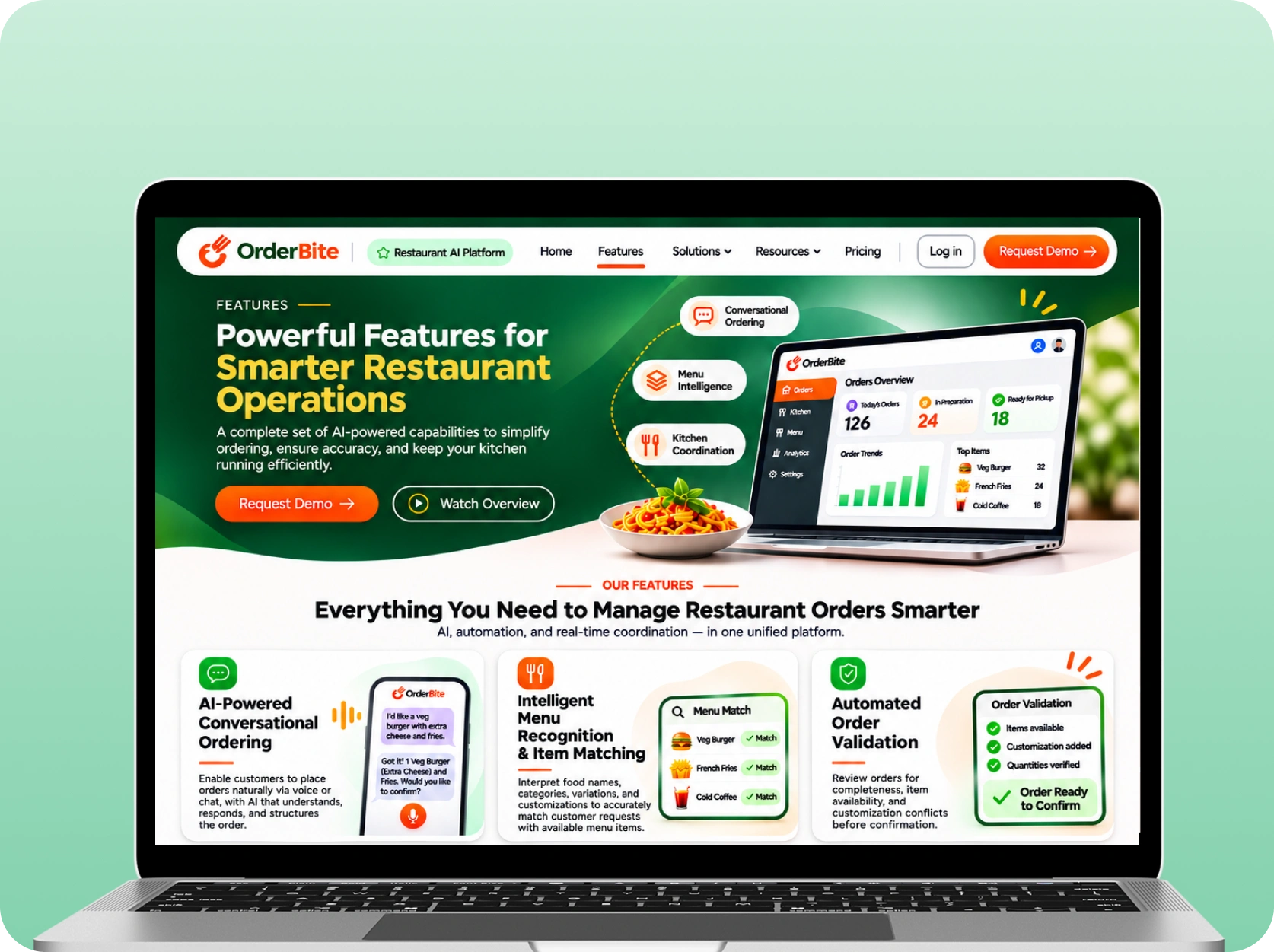
An intelligent restaurant order management platform designed to simplify customer ordering, improve order accuracy, and streamline kitchen operations through AI-powered automation. The solution brings conversational ordering, menu intelligence, order validation, centralized order management, and kitchen coordination into a unified digital ecosystem. By reducing repetitive manual activities and connecting customer interactions with restaurant workflows, the platform aims to create a more efficient and consistent ordering experience.
Introduction
Restaurants handling high volumes of customer orders often face operational challenges involving order miscommunication, incorrect item selections, complex menu customizations, and disconnected order management processes. Manual order entry and repetitive confirmation activities can increase staff workloads, slow down service delivery, and affect the overall customer experience.
The objective was to conceptualize OrderBite, an AI-powered restaurant order intelligence platform that simplifies the complete ordering journey, from initial customer interaction to kitchen order fulfillment. The solution was designed to combine conversational AI, intelligent menu interpretation, automated order validation, and centralized order processing. It also required seamless integration with restaurant management systems, real-time order updates, and a scalable technical architecture capable of supporting changing menu configurations and increasing order volumes.
Tech Stack
 React.js
 Node.js
 OpenAI Whisper
 Twilio Voice
 PostgreSQL
 AWS
Key Features

AI-Powered Conversational Order Management
Designed an intelligent ordering experience that enables customers to communicate their food preferences through natural voice interactions. AI-powered conversational capabilities help interpret customer requests, identify relevant menu items, and organize order information into structured records. The system aims to simplify phone-based ordering while reducing repetitive communication between customers and restaurant staff.
Intelligent Menu Recognition & Item Matching
Developed a conceptual menu intelligence layer to interpret different food names, menu categories, item variations, and customer preferences. The functionality helps connect conversational requests with available menu options while accounting for item descriptions, portion sizes, and customization requirements. This creates a more structured ordering experience and reduces ambiguity during customer interactions.
Automated Order Validation & Customization Handling
Introduced an intelligent order validation workflow to review selected items, quantities, special instructions, and customization requests before order confirmation. The system can identify incomplete selections, unavailable menu items, and conflicting order details, prompting clarification when required. This approach helps improve order completeness and reduces avoidable corrections during subsequent processing.
Centralized Order Processing & POS Integration
Designed a centralized order processing environment that organizes confirmed customer requests and connects them with restaurant management workflows. API-based integrations provide a foundation for synchronizing order information with compatible Point of Sale (POS) systems. This functionality helps reduce duplicate data entry, improve order visibility, and support consistent information exchange across restaurant operations.
Real-Time Kitchen Order Coordination
Created a structured kitchen coordination workflow to route confirmed orders to the appropriate preparation teams. Order status updates help restaurant staff monitor incoming requests, preparation progress, and completed orders through a centralized interface. The approach supports better coordination between front-of-house and kitchen teams while helping restaurants manage changing order volumes.
Restaurant Operations Dashboard & Analytics
Designed an administrative dashboard to organize restaurant orders, customer interactions, order statuses, and operational activity. Reporting capabilities provide a foundation for reviewing order volumes, frequently requested menu items, common order modifications, and processing trends. These insights can help restaurant managers identify operational bottlenecks and make more informed decisions about service improvements.
Challenges
-
Order Misinterpretation & Inconsistent Customer Requests
Voice-based ordering can introduce ambiguity due to different accents, background noise, unclear pronunciations, and customer-specific food preferences. Converting conversational requests into structured and actionable order information required an intelligent interpretation and clarification workflow.
-
Complex Menu Structures & Customizations
Restaurant menus frequently include multiple categories, item variations, optional ingredients, portion sizes, and special instructions. Mapping different customer expressions to the correct menu selections required a flexible menu intelligence layer capable of handling variations and contextual requests.
-
Order Accuracy & Validation Requirements
Incomplete selections, incorrect quantities, unavailable items, and conflicting customization requests can create problems during order fulfillment. Establishing automated validation workflows was important to identify potential inconsistencies before confirmed orders moved into kitchen operations.
-
Integration with Existing Restaurant Systems
Connecting AI-powered ordering functionality with existing POS platforms and restaurant management systems introduced integration and data synchronization requirements. The solution needed a flexible API architecture to support reliable information exchange without unnecessarily disrupting existing restaurant workflows.
-
Operational Efficiency During Peak Hours
High-volume ordering periods can increase pressure on restaurant employees and create delays across customer communication, order entry, and kitchen coordination. The platform needed centralized order visibility and automated workflows to support more organized restaurant operations during busy periods.
Our Approach
-
Requirement Analysis & Platform Architecture
Defined the core restaurant ordering workflows and identified opportunities for AI-assisted automation across customer interactions, menu management, order processing, and kitchen coordination. Established a modular architecture to support different restaurant requirements, flexible menu structures, and future system integrations.
-
AI Integration & Conversational Intelligence
Planned an AI-driven conversational layer using OpenAI technologies to interpret customer requests and organize relevant order information. Integrated Twilio Programmable Voice as the proposed voice communication layer, with audio processing and transcription workflows designed to support reliable voice-based interactions.
-
Menu Intelligence & Order Validation
Designed structured menu data models and intelligent order validation workflows to connect customer requests with available menu items. Incorporated validation logic for item availability, quantities, variations, and customization requirements, with clarification workflows for ambiguous or incomplete requests.
-
Backend Development & System Integrations
Focused on developing backend services using Node.js and Python to manage AI processing, order workflows, and business logic. Planned REST API integrations with compatible POS and restaurant management systems, supported by PostgreSQL and Redis for application data and efficient information access.
-
Cloud Deployment & Quality Assurance
Selected AWS-based infrastructure and Docker containerization as the proposed deployment foundation. Emphasized functional testing, voice interaction validation, API integration testing, order workflow verification, and performance assessments to establish a reliable platform capable of supporting evolving restaurant operational requirements.
Results & Impact
OrderBite establishes a foundation for more organized and automated restaurant ordering operations. By connecting conversational ordering, menu interpretation, order validation, POS integration, and kitchen coordination, the solution aims to simplify the movement of customer requests across different operational stages.
The integrated approach helps reduce dependency on repetitive manual order entry while creating a more structured environment for managing customer interactions and restaurant workflows. Centralized order information and operational dashboards also provide greater visibility into order activities, creating opportunities for continuous process improvements.
Key expected business benefits include:
-
Improved Order Accuracy
Supports structured order interpretation and automated validation to reduce inconsistencies in customer requests.
-
Faster Order Processing
Automates repetitive ordering activities and simplifies the transition from customer interaction to confirmed orders.
-
Reduced Manual Workload
Helps restaurant employees spend less time on repetitive order entry and clarification activities.
-
Streamlined Kitchen Coordination
Organizes confirmed orders and preparation workflows through centralized order management.
-
Better Operational Visibility
Provides structured dashboards and reporting capabilities to monitor restaurant ordering activities.
-
Scalable Restaurant Operations
Establishes a flexible technical foundation for additional restaurant integrations, AI capabilities, and increasing order volumes.

Let’s Build Something
Exceptional
Innovify transforms ideas into impactful products, blending design and engineering from concept to scale. Through onshore and nearshore collaboration, we deliver speed, clarity, and top talent without compromise.
Visit Portfolio
See More Case Studies
Our clients speak for us! Our Clutch-verified reviews reflect our dedication to delivering top-notch solutions.