All Case Study

Plinth: AI-Powered Property Maintenance & Facilities Operations Management Platform
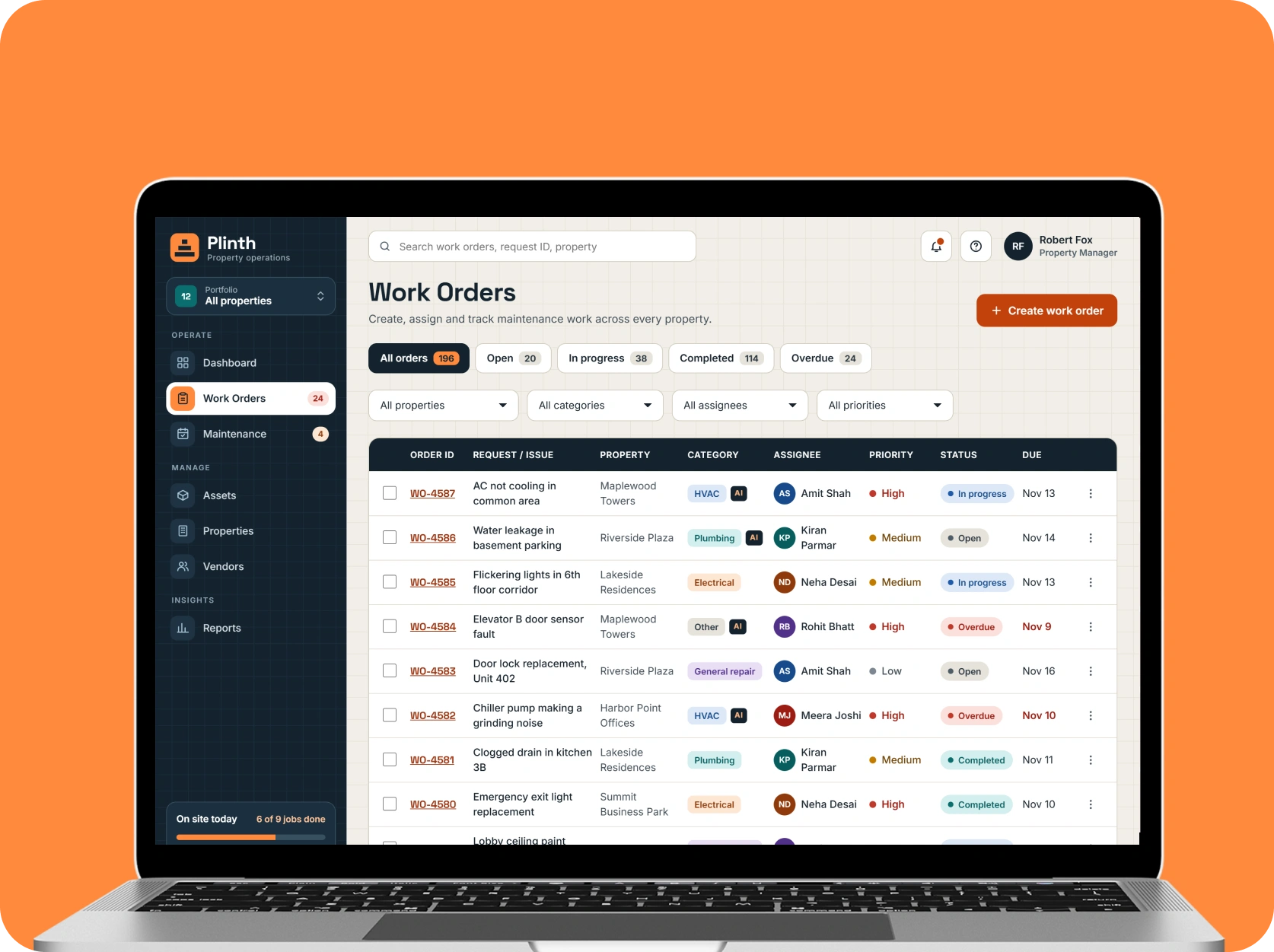
An intelligent property management solution designed to streamline facility maintenance, automate service coordination, and improve operational visibility across residential and commercial properties. The platform combines AI-assisted request classification, centralized asset management, preventive maintenance scheduling, vendor coordination, and performance analytics to help property operators manage maintenance activities more efficiently.
Introduction
Managing residential and commercial properties involves coordinating maintenance requests, monitoring building assets, scheduling repairs, and ensuring that service activities are completed within expected timelines. When these operations rely on spreadsheets, phone calls, and disconnected management systems, property operators can experience delayed responses, inefficient resource allocation, limited maintenance visibility, and inconsistent service records.
Plinth addresses these operational challenges through a centralized digital ecosystem. It enables property managers to manage building information, receive maintenance requests, prioritize service activities, coordinate technicians, and monitor work order progress from a unified interface.
By incorporating AI-assisted request classification and operational analytics, the platform helps teams organize maintenance activities, identify recurring service issues, and make informed decisions about property upkeep. It provides a scalable foundation for managing multiple properties, maintenance teams, and external service providers within a connected operational environment.
Tech Stack
 Next.js
 React Native
 NestJS
 PostgreSQL
 OpenAI API
 Google Maps API
Key Features

Centralized Property & Asset Management
Provides a unified platform for managing residential and commercial properties, building information, equipment records, and maintenance-related assets. Administrators can organize properties by location, maintain asset specifications, track installation details, and access historical maintenance records. This centralized structure helps property operators maintain consistent information across multiple buildings and facilities.
AI-Powered Maintenance Request Classification
Uses AI-assisted processing to analyze incoming maintenance requests submitted by tenants, employees, or property representatives. The system can categorize reported issues, identify relevant maintenance types, and recommend priority levels based on request details and predefined operational rules. This helps service teams organize incoming requests and direct them to the appropriate maintenance workflow.
Intelligent Work Order Management
Enables property managers to create, assign, monitor, and manage maintenance work orders through a centralized dashboard. Requests can be converted into actionable service tasks with descriptions, assigned technicians, target completion dates, and progress statuses. Teams can track pending, ongoing, completed, and overdue activities while maintaining a structured history of maintenance operations.
Preventive Maintenance Scheduling
Supports planned maintenance activities based on equipment specifications, servicing intervals, asset history, and operational requirements. Property managers can establish recurring maintenance schedules, assign responsibilities, and receive notifications for upcoming servicing activities. This approach helps organizations maintain equipment more consistently and reduce dependency on reactive maintenance practices.
Vendor & Technician Coordination
Provides centralized coordination between property administrators, internal maintenance personnel, and external service providers. Managers can assign service requests, track technician availability, monitor work progress, and maintain vendor-related records. The platform helps organize service responsibilities and provides better visibility into the execution of maintenance activities across different properties.
Operational Analytics & Maintenance Reporting
Offers reporting capabilities covering maintenance requests, work order completion, asset service histories, recurring issues, vendor performance, and maintenance expenses. Administrators can review operational trends, identify frequently reported problems, and evaluate maintenance activities across properties. These insights support more effective resource planning and property operations management.
Challenges
-
Fragmented Property Maintenance Operations
Managing maintenance activities across multiple buildings and properties can become difficult when service requests, asset records, and technician assignments are maintained through disconnected systems. A centralized operational environment was required to improve information accessibility and coordination.
-
Delayed Maintenance Request Processing
Incoming service requests often require manual review, categorization, prioritization, and assignment. Without structured request management, urgent issues can remain unattended while maintenance teams spend additional time organizing routine service activities.
-
Limited Preventive Maintenance Visibility
Maintaining equipment and building assets requires consistent servicing schedules and accessible maintenance histories. Without centralized tracking, property operators may struggle to identify upcoming maintenance requirements and recurring asset-related issues.
-
Complex Vendor & Technician Coordination
Coordinating internal technicians and external service providers across multiple locations creates operational challenges. Property managers require clear visibility into task assignments, service progress, completion timelines, and vendor responsibilities.
Our Approach
-
Property Management Architecture & Workflow Assessment
Evaluated property administration requirements, maintenance processes, asset management needs, user roles, and service coordination workflows. Based on these requirements, we structured a centralized application architecture capable of supporting multiple properties, maintenance teams, and operational activities.
-
AI-Assisted Request Processing & Automation
Designed an intelligent request processing approach to organize incoming maintenance information, categorize service requirements, and assist with task prioritization. AI integration and rule-based workflows were considered to simplify request handling while maintaining administrative control over important maintenance decisions.
-
Work Order & Preventive Maintenance Development
Established structured workflows for maintenance task creation, technician assignment, service scheduling, progress tracking, and completion management. The solution approach focused on connecting asset records with maintenance activities to provide better operational visibility and more organized service coordination.
-
Cloud Integration, Security & Platform Optimization
Structured the application infrastructure around secure authentication, role-based permissions, cloud data storage, API integration, and scalable deployment. The validation approach considered property data management, work order workflows, notification delivery, application performance, and administrative access requirements.
Results & Impact
Plinth establishes a centralized environment for managing property assets, coordinating maintenance activities, and improving service visibility across residential and commercial facilities.
By combining intelligent request processing, work order management, preventive maintenance scheduling, and operational reporting, the platform provides a structured approach to property maintenance administration. Property managers gain a unified view of service requests, technician assignments, asset records, and maintenance activities, while operational teams benefit from more organized task coordination.
The platform’s modular architecture also provides a foundation for expanding property portfolios, integrating additional service providers, and introducing further AI-assisted operational capabilities as business requirements evolve.
Business Benefits:
- Centralized management of residential and commercial property information
- Improved organization of maintenance requests and service activities
- AI-assisted classification and prioritization of maintenance requirements
- Structured work order creation, assignment, and tracking
- Better visibility into preventive maintenance schedules
- Improved coordination between property managers, technicians, and vendors
- Centralized asset records and maintenance histories
- Operational insights through maintenance analytics and reporting
- Scalable architecture for managing multiple properties and facilities

Let’s Build Something
Exceptional
Innovify transforms ideas into impactful products, blending design and engineering from concept to scale. Through onshore and nearshore collaboration, we deliver speed, clarity, and top talent without compromise.
Visit Portfolio
See More Case Studies
Our clients speak for us! Our Clutch-verified reviews reflect our dedication to delivering top-notch solutions.