All Case Study

RetailVista: Unified Retail Intelligence & Store Operations Platform
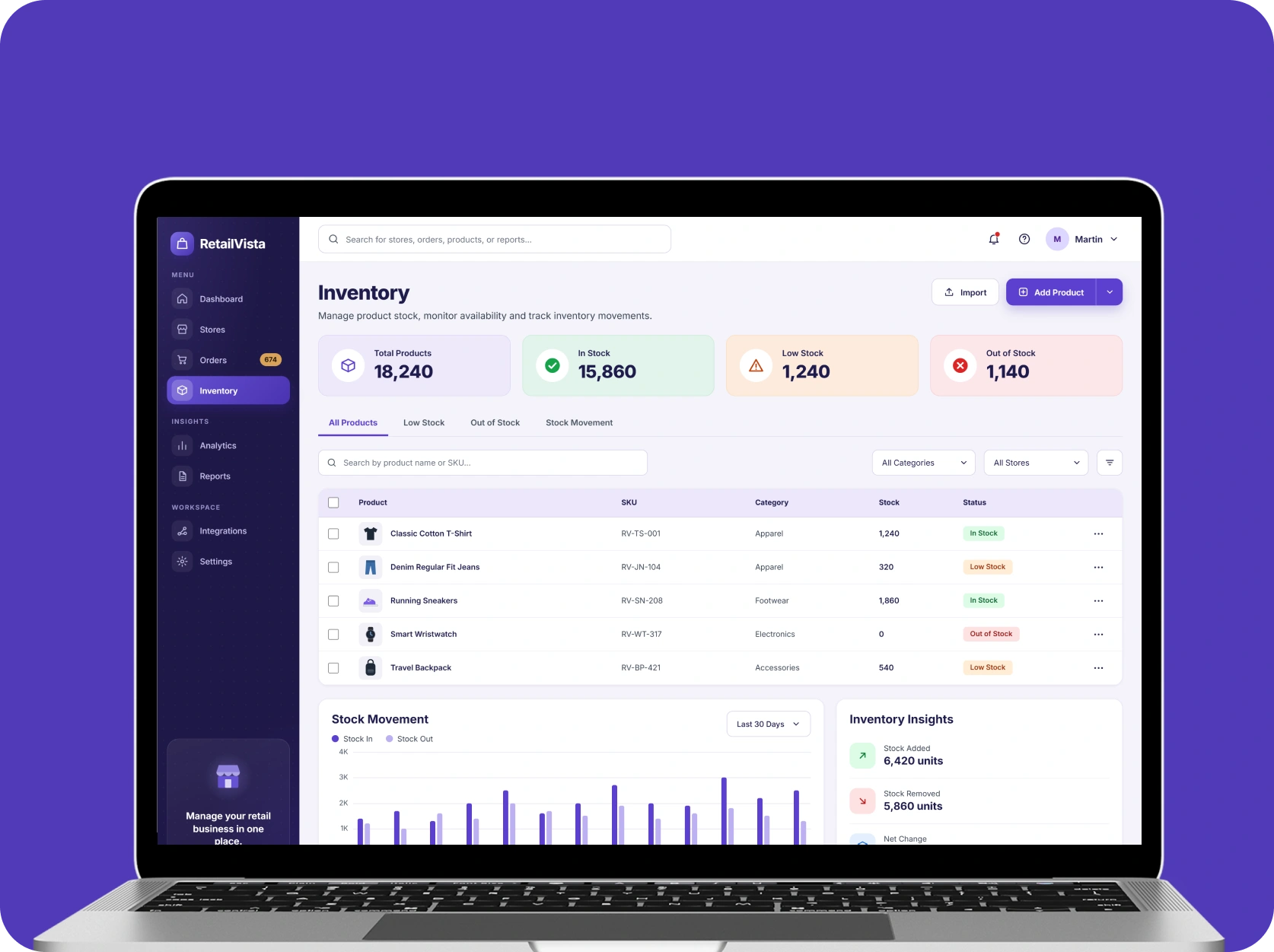
RetailVista is a centralized retail intelligence and operations platform designed to help eCommerce businesses monitor sales performance, track inventory activities, and manage multiple store operations through a unified digital environment. The platform brings together business analytics, inventory visibility, order monitoring, and operational reporting to help retailers gain better control over their commerce activities. With centralized data management and actionable insights, RetailVista aims to simplify retail operations, improve business visibility, and support data-driven decision-making.
Introduction
Retail businesses operating across multiple sales channels often struggle to maintain visibility into sales performance, inventory movements, order activities, and overall business operations. Disconnected systems and manually maintained reports can create information gaps, delay operational decisions, and make it difficult to identify business performance trends.
RetailVista was conceptualized to address these challenges through a centralized retail intelligence platform that connects essential commerce operations with business reporting capabilities. The solution focuses on consolidating operational data, simplifying inventory monitoring, providing actionable sales insights, and improving visibility across multiple retail locations.
By combining interactive dashboards, automated reporting, inventory monitoring, and integration capabilities, the platform provides retailers with a structured environment to manage business information and make more informed operational decisions.
Tech Stack
 React.js
 Node.js
 PostgreSQL
 REST APIs
 AWS
 Magento Integration
Key Features

Centralized Retail Performance Dashboard
Developed a centralized dashboard concept to provide retailers with an overview of their business performance through a unified interface. The dashboard brings together important business indicators, including sales activity, order volume, revenue trends, and operational summaries. Interactive visualizations help business administrators understand performance patterns and identify areas requiring attention.
Multi-Store Operations Management
Designed a centralized management environment to support businesses operating across multiple retail locations. Administrators can monitor individual store activities, compare operational performance, and access consolidated business information. This approach simplifies multi-location oversight while providing better visibility into store-level activities and overall business performance.
Inventory Visibility & Stock Monitoring
Introduced inventory monitoring capabilities to help businesses maintain visibility into product availability, stock movements, and inventory levels. The platform provides structured inventory information to support stock monitoring and replenishment planning. Retail administrators can identify products requiring attention and make informed inventory-related decisions.
Sales Analytics & Business Intelligence
Integrated business intelligence capabilities to transform operational data into meaningful performance insights. Retailers can analyze sales trends, compare business performance across different periods, and evaluate product-level performance through interactive reports. These insights support better business planning, sales monitoring, and operational decision-making.
Order Tracking & Operational Monitoring
Designed order monitoring functionality to provide visibility into order activities and fulfillment progress. The platform organizes order information into structured views, helping administrators monitor order statuses, identify pending activities, and maintain better oversight of daily commerce operations.
Automated Reporting & Business Notifications
Introduced automated reporting capabilities to reduce manual data compilation and improve access to business information. Scheduled reports and configurable notifications help administrators stay informed about important operational activities, inventory changes, and business performance indicators without continuously monitoring multiple systems.
Third-Party Commerce System Integration
Designed an integration framework to connect the platform with existing eCommerce systems, inventory databases, and business applications through APIs. Centralized data synchronization helps reduce information fragmentation and creates a consistent operational view across connected business systems.
Challenges
-
Fragmented Business Information
Retail businesses frequently maintain sales, inventory, order, and customer information across multiple applications and databases. Accessing consolidated business information becomes difficult when systems operate independently. The challenge was to establish a centralized environment capable of bringing essential retail information together.
-
Limited Multi-Store Performance Visibility
Businesses operating across multiple locations often struggle to compare individual store performance and understand overall operational efficiency. The platform needed to provide consolidated reporting while preserving visibility into individual store activities and business performance.
-
Inventory Monitoring & Stock Accuracy
Maintaining accurate inventory visibility becomes increasingly complicated when product information and stock movements are distributed across different systems. The solution required structured inventory monitoring capabilities to help businesses identify stock-related issues and improve replenishment planning.
-
Manual Reporting & Delayed Business Insights
Traditional reporting processes often depend on manually collecting and consolidating information from different sources. This can delay access to important business insights and increase administrative workloads. The platform needed to simplify reporting and make relevant performance information easier to access.
-
Integration & Data Synchronization Complexity
Connecting multiple commerce systems and business applications requires consistent data exchange and reliable integration workflows. The challenge was to establish a scalable integration architecture that could support centralized reporting while maintaining data consistency across connected systems.
Our Approach
-
Centralized Platform Architecture
Designed a centralized application architecture to consolidate essential retail information into a unified operational environment. The platform structure focuses on organizing sales, inventory, order, and store-related information to improve accessibility and simplify business administration.
-
Interactive Dashboard & Analytics Development
Developed an interactive dashboard approach to present important business indicators through structured reports and visual representations. The implementation focuses on making sales trends, operational summaries, and performance comparisons easier for administrators to understand.
-
Inventory & Store Operations Management
Established structured inventory and multi-store management workflows to improve visibility into product availability and individual store activities. Centralized operational information helps administrators monitor inventory conditions and maintain better oversight across business locations.
-
Reporting & Notification Automation
Incorporated automated reporting and notification workflows to minimize manual administrative activities. The solution enables business administrators to access relevant operational updates and performance information through organized reporting mechanisms.
-
API-Based System Integration
Designed API-based integration capabilities to connect existing commerce platforms and business applications. The integration approach focuses on consistent data exchange, centralized information management, and improved visibility across connected operational systems.
-
Quality Assurance & Platform Optimization
Established a structured quality assurance approach covering functional validation, data synchronization, reporting accuracy, and integration testing. The focus was on delivering a reliable platform experience while supporting future business expansion and additional integrations.
Results & Impact
RetailVista establishes a centralized approach to retail intelligence and operational management by bringing essential business information into a unified platform. The solution’s proposed architecture helps reduce information fragmentation and provides retailers with improved visibility into sales activities, inventory conditions, order monitoring, and multi-store performance.
Centralized dashboards and business intelligence capabilities make operational information easier to interpret, helping administrators identify performance trends and make more informed business decisions. Inventory monitoring and structured order management further support day-to-day retail activities, while automated reporting reduces dependency on manual information compilation.
The platform’s API-based integration approach also creates opportunities to connect existing commerce applications and business systems within a unified operational environment. Overall, RetailVista represents a scalable retail intelligence solution designed to simplify business administration, strengthen operational visibility, and support data-driven retail growth.
Visit Portfolio
Let’s Build Something
Exceptional
Innovify transforms ideas into impactful products, blending design and engineering from concept to scale. Through onshore and nearshore collaboration, we deliver speed, clarity, and top talent without compromise.
Visit Portfolio
See More Case Studies
Our clients speak for us! Our Clutch-verified reviews reflect our dedication to delivering top-notch solutions.