All Case Study

VisionSense: AI-Based Object Discovery & Spatial Awareness System
An intelligent visual search solution that helps users identify everyday objects and understand their positions within a physical environment. Powered by computer vision and deep learning, the system combines object recognition, spatial localization, and voice-based search input to make environmental information more accessible. Its detection capabilities are designed to recognize more than 80 everyday object categories within an approximate range of 2–5 meters.
Introduction
Finding specific objects in unfamiliar or visually complex surroundings can be challenging, particularly for people who experience visual impairments. Conventional object identification methods often require direct visual attention, making it difficult to locate particular items or understand their positions in real-world environments.
VisionSense is an AI-powered object discovery system that uses computer vision to identify objects from captured images and determine their approximate locations. Rather than limiting the process to general image classification, the solution focuses on detecting multiple object categories and identifying their positions through bounding-box predictions.
The system also incorporates speech-to-text functionality, allowing users to provide the name of an object they want to identify. By combining voice-based input with intelligent visual detection, the solution creates a more accessible way to search for objects and interpret surrounding environments.
Tech Stack
 Python
 YOLO
 OpenCV
 CNN
 Speech-to-Text
Key Features

AI-Powered Object Discovery
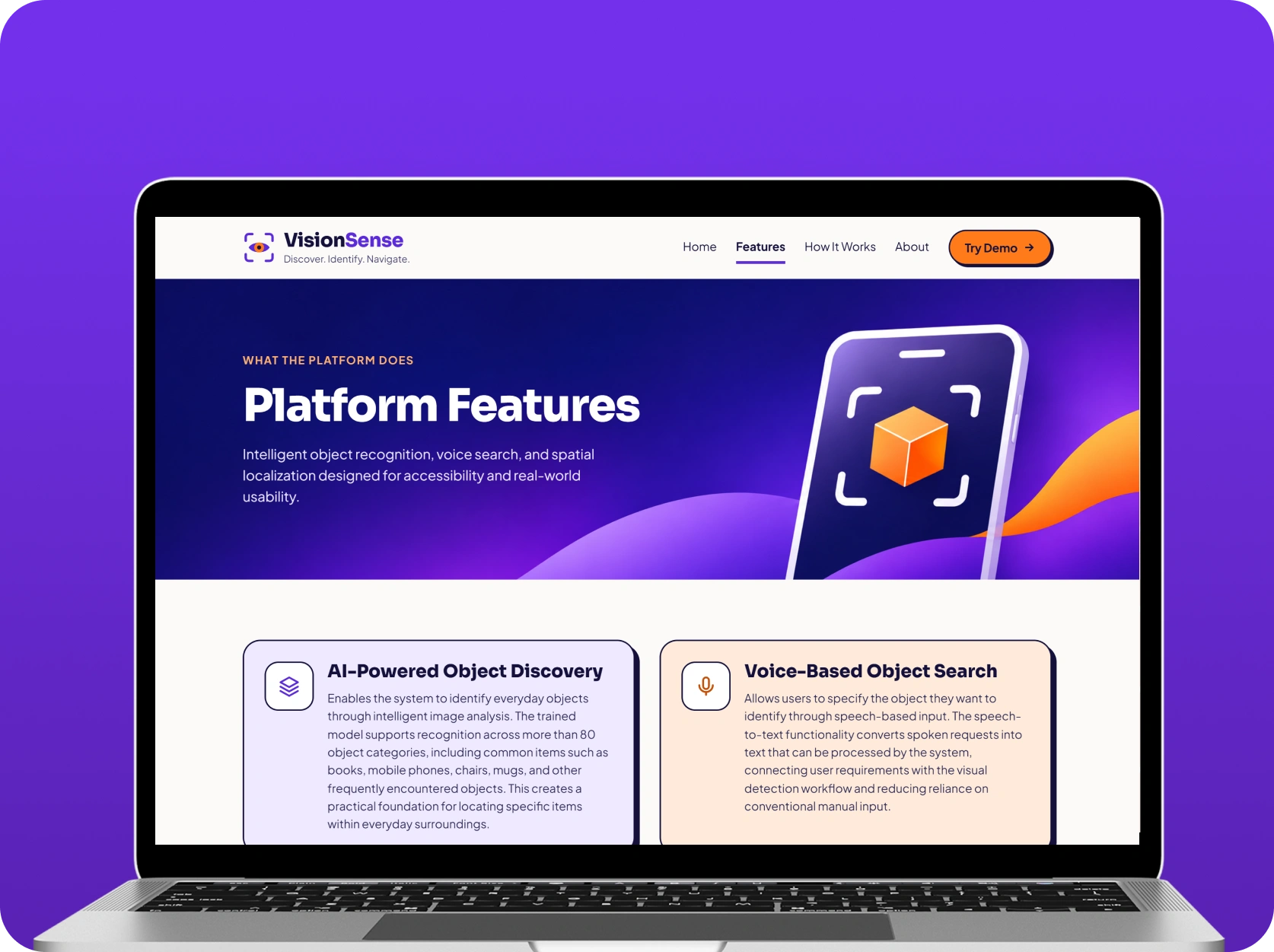
Enables the system to identify everyday objects through intelligent image analysis. The trained model supports recognition across more than 80 object categories, including common items such as books, mobile phones, chairs, mugs, and other frequently encountered objects. This creates a practical foundation for locating specific items within everyday surroundings.
Voice-Based Object Search
Allows users to specify the object they want to identify through speech-based input. The speech-to-text functionality converts spoken requests into text that can be processed by the system, connecting user requirements with the visual detection workflow and reducing reliance on conventional manual input.
Spatial Object Localization
Identifies the approximate position of detected objects within captured images using bounding-box predictions. This capability provides more context than object classification alone, helping the system distinguish not only what an object is but also where it appears in the visual frame.
Multi-Object Recognition
Supports the identification of different object categories through a trained deep learning model. The detection workflow is designed to process visual information and recognize relevant objects within the same environment, making it useful for applications that require broader environmental awareness.
Distance-Based Detection
Uses YOLO-based detection to identify objects within an approximate operating range of 2–5 meters. This capability supports object discovery in nearby surroundings and provides a defined detection range for the intended application.
Assistive Technology Integration Potential
Creates opportunities to incorporate intelligent object recognition into wearable applications and other assistive technology solutions. The combination of visual detection, object localization, and voice-based input provides a foundation for developing accessible digital experiences for people with visual impairments.
Challenges
-
Building a Reliable Object Recognition Dataset
Training a model to recognize a wide range of everyday objects requires sufficient image samples and consistent data preparation. The project involved using approximately 1,000 images per object category, making dataset organization and model training important technical considerations.
-
Managing Model Training Performance
Processing large image datasets and executing deep learning training scripts can require significant computational resources and time. Maintaining an efficient training workflow while minimizing conflicts between object categories was an important development challenge.
-
Combining Object Identification with Spatial Detection
Recognizing an object is only one part of environmental understanding. The system also needed to determine where detected objects appeared within an image. Coordinating object classification with bounding-box predictions introduced additional complexity to the detection process.
-
Supporting Practical Object Discovery
Developing a useful object discovery experience required connecting the recognition engine with user requirements. The system needed to process requested object names and identify relevant visual matches while supporting the intended detection distance and application use cases.
Our Approach
-
Dataset Preparation & Deep Learning Model Development
Established an image-based training workflow using a collection of approximately 1,000 images for each object category. Python-based development and deep learning techniques were used to train the recognition model to distinguish different everyday objects and improve its ability to interpret visual inputs.
-
YOLO-Based Object Detection Implementation
Applied the YOLO object detection approach to process images and identify multiple object categories. The model uses a single neural network for its detection workflow, supporting object recognition and localization within the same processing pipeline.
-
OpenCV-Based Image Processing
Integrated OpenCV with Python to support image processing and the object detection workflow. CNN-based techniques evaluate object classes and bounding-box predictions, enabling the system to identify recognized objects and represent their positions within captured images.
-
Voice-Based Search Integration
Incorporated speech-to-text functionality to allow users to specify the objects they want to find. This connects voice input with the visual recognition process and provides an alternative interaction method for accessing object discovery capabilities.
-
Detection Workflow Optimization
Focused on developing an efficient detection pipeline that combines image inputs, trained model predictions, and distance-based detection parameters. This approach supports object recognition within the intended operating range and provides a foundation for potential integration into assistive applications.
Results & Impact
VisionSense demonstrates how AI-powered visual search can help identify everyday objects and provide additional information about their positions within an environment. With support for more than 80 object categories and an approximate detection range of 2–5 meters, the system establishes a practical foundation for intelligent object discovery.
Its combination of YOLO-based detection, CNN techniques, and OpenCV image processing enables the system to analyze visual inputs and generate object localization results. Speech-to-text functionality adds an alternative way for users to specify their object search requirements.
The project also creates opportunities for extending computer vision capabilities into wearable applications and other assistive technology environments. Overall, the solution highlights the potential of combining AI-based object recognition, spatial awareness, and voice interaction to make environmental information more accessible.
Visit Portfolio
Let’s Build Something
Exceptional
Innovify transforms ideas into impactful products, blending design and engineering from concept to scale. Through onshore and nearshore collaboration, we deliver speed, clarity, and top talent without compromise.
Visit Portfolio
See More Case Studies
Our clients speak for us! Our Clutch-verified reviews reflect our dedication to delivering top-notch solutions.