All Case Study

CatalogHub: Streamlining Digital Product Experiences
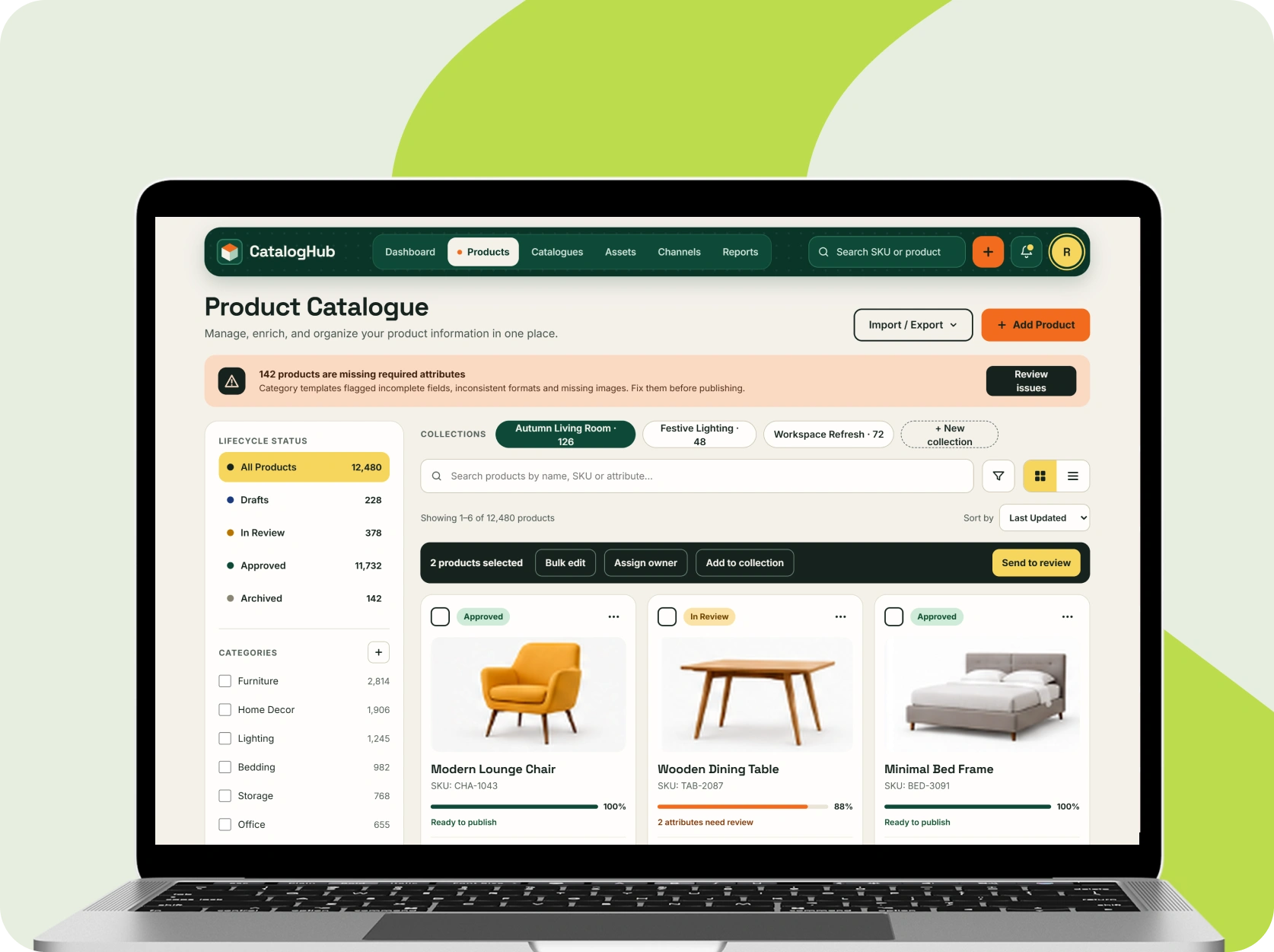
A centralized product information management platform designed to help businesses organize product data, enrich catalogue information, coordinate merchandising activities, and distribute consistent product experiences across multiple digital channels. The solution brings product attributes, media assets, categorization, pricing information, and publishing workflows into one connected environment.
Introduction
Businesses operating across multiple digital sales channels often manage extensive product catalogues containing descriptions, specifications, images, pricing details, categories, and other product attributes. When this information is maintained across disconnected systems and spreadsheets, keeping product data accurate and consistent becomes increasingly challenging.
To address these operational complexities, NinjaTech proposes CatalogHub, a product information and omnichannel catalog management platform that enables businesses to centralize product information and coordinate catalogue operations through structured workflows. The solution is designed to simplify product onboarding, standardize product attributes, manage catalogue enrichment, and support publishing across connected e-commerce platforms and digital channels.
Rather than functioning as a conventional document repository, the platform focuses on product data quality, catalogue organization, merchandising coordination, and channel readiness. Its modular architecture can support retailers, manufacturers, distributors, and businesses managing large or frequently changing product inventories.
Tech Stack
 Next.js
 NestJS
 PostgreSQL
 Elasticsearch
 GraphQL
 AWS
Key Features

Centralized Product Information Management
The platform provides a unified workspace for managing product information across multiple categories and business units. Authorized users can create product records containing names, descriptions, specifications, identifiers, dimensions, variants, pricing details, and other relevant attributes.
A configurable product data structure allows businesses to define category-specific fields and maintain consistent information standards. Centralized records reduce duplication and make it easier for teams to access reliable product information when preparing catalogues for different digital channels.
Product Catalogue Enrichment & Attribute Management
The solution supports structured product enrichment by allowing teams to add, update, and validate product attributes according to defined catalogue requirements. Category-based templates help ensure that products contain the necessary specifications before they become available for publication.
Validation rules can identify incomplete fields, inconsistent formats, and missing product information. Bulk editing and import capabilities can further simplify the management of large catalogues, helping teams process product updates more efficiently.
Digital Asset & Product Media Coordination
Product presentation often requires multiple images, videos, technical illustrations, and other visual assets. The platform provides a structured way to associate these media resources with relevant product records.
Teams can organize assets using product identifiers, categories, tags, and usage attributes. Image previews and asset assignment workflows help ensure that the correct visual materials are associated with the appropriate products before channel publication.
Product Lifecycle & Merchandising Workflow
The platform supports product information workflows from initial onboarding through review, approval, and publication. Users can assign responsibilities, update product statuses, and track catalogue readiness through configurable stages.
Merchandising teams can organize product collections, highlight selected items, manage category placements, and coordinate promotional catalogue updates. This creates a more structured process for preparing product information and maintaining catalogue quality across business operations.
Omnichannel Catalogue Distribution & API Integration
The solution is designed to connect centralized product records with multiple digital commerce channels through APIs and configurable data mappings. Businesses can prepare channel-specific product information while maintaining a consistent master catalogue.
The platform can support integrations with e-commerce storefronts, marketplaces, ERP systems, and other business applications, depending on available APIs and integration requirements. Synchronization workflows can help teams identify pending updates, monitor publishing status, and manage data consistency between connected systems.
Catalogue Analytics & Data Quality Monitoring
An administrative dashboard provides visibility into catalogue completeness, product approval status, publishing activity, data validation issues, and channel synchronization. Users can review product records requiring attention and identify recurring catalogue management problems.
Reporting capabilities can help businesses understand catalogue readiness, monitor enrichment progress, and evaluate operational performance. These insights support more informed decisions about product data quality and digital merchandising activities.
Challenges
-
Fragmented Product Information
Product details were difficult to manage consistently when information was distributed across spreadsheets, business applications, and individual channel systems. A centralized data environment was needed to provide teams with a reliable source of product information.
-
Inconsistent Catalogue Attributes
Different product categories and sales channels can require different specifications, formats, and mandatory attributes. Maintaining these standards manually can result in incomplete records and inconsistent product presentation.
-
Complex Product Media Coordination
Product images and supporting media need to be correctly associated with individual products and variants. Disorganized asset handling can create duplication, incorrect image assignments, and additional manual effort during catalogue preparation.
-
Difficult Multi-Channel Synchronization
Updating product information across multiple commerce platforms can introduce delays and inconsistencies. A structured integration approach was required to coordinate catalogue updates and provide better visibility into synchronization activities.
Our Approach
-
Product Data Assessment & Architecture Planning
Reviewed the proposed business requirements, product categories, existing catalogue structures, data sources, and channel integration needs. These findings were used to define the product information model, attribute standards, user roles, and implementation roadmap.
-
Modular Platform & Catalogue Development
Designed a modular platform architecture to support product onboarding, attribute management, media coordination, merchandising workflows, and catalogue reporting. The system structure was planned to accommodate expanding product categories and evolving business requirements.
-
Workflow Automation & Data Validation
Introduced configurable catalogue workflows to organize product review, enrichment, approval, and publication activities. Validation rules and structured data requirements were designed to help identify incomplete product records and improve catalogue consistency.
-
Integration, Testing & Continuous Enhancement
Planned API-based connectivity with relevant commerce and business systems, followed by functional, integration, and data validation testing. The delivery approach includes controlled deployment, user feedback, and iterative enhancements to support evolving catalogue and channel requirements.
Results & Impact
CatalogHub provides a structured foundation for managing product data and coordinating catalogue operations across digital business channels. By connecting product records, category attributes, media assets, merchandising workflows, and channel integrations, the solution is designed to reduce fragmented information management and improve operational visibility.
A centralized product information environment can help teams maintain more consistent catalogue records while making product enrichment and publication activities easier to coordinate. Structured validation and workflow tracking also provide better visibility into incomplete product information and updates requiring attention.
The platform is designed to deliver the following business benefits:
-
Centralized Product Information
Brings product descriptions, specifications, attributes, and variants into a unified data environment.
-
Improved Catalogue Consistency
Supports standardized product attributes and validation rules across categories.
-
Organized Media Management
Connects product images and supporting assets with relevant catalogue records.
-
Streamlined Merchandising Workflows
Structures product review, enrichment, approval, and publishing activities.
-
Connected Digital Channels
Supports product information distribution through integrations with e-commerce platforms and business applications.
-
Better Catalogue Visibility
Provides reporting on product completeness, publishing status, and data quality.
-
Scalable Catalogue Operations
Establishes a modular foundation for expanding product categories, channels, and integrations.

Let’s Build Something
Exceptional
Innovify transforms ideas into impactful products, blending design and engineering from concept to scale. Through onshore and nearshore collaboration, we deliver speed, clarity, and top talent without compromise.
Visit Portfolio
See More Case Studies
Our clients speak for us! Our Clutch-verified reviews reflect our dedication to delivering top-notch solutions.