All Case Study

CustomsPlus: Customs Document Classification & Automation Platform
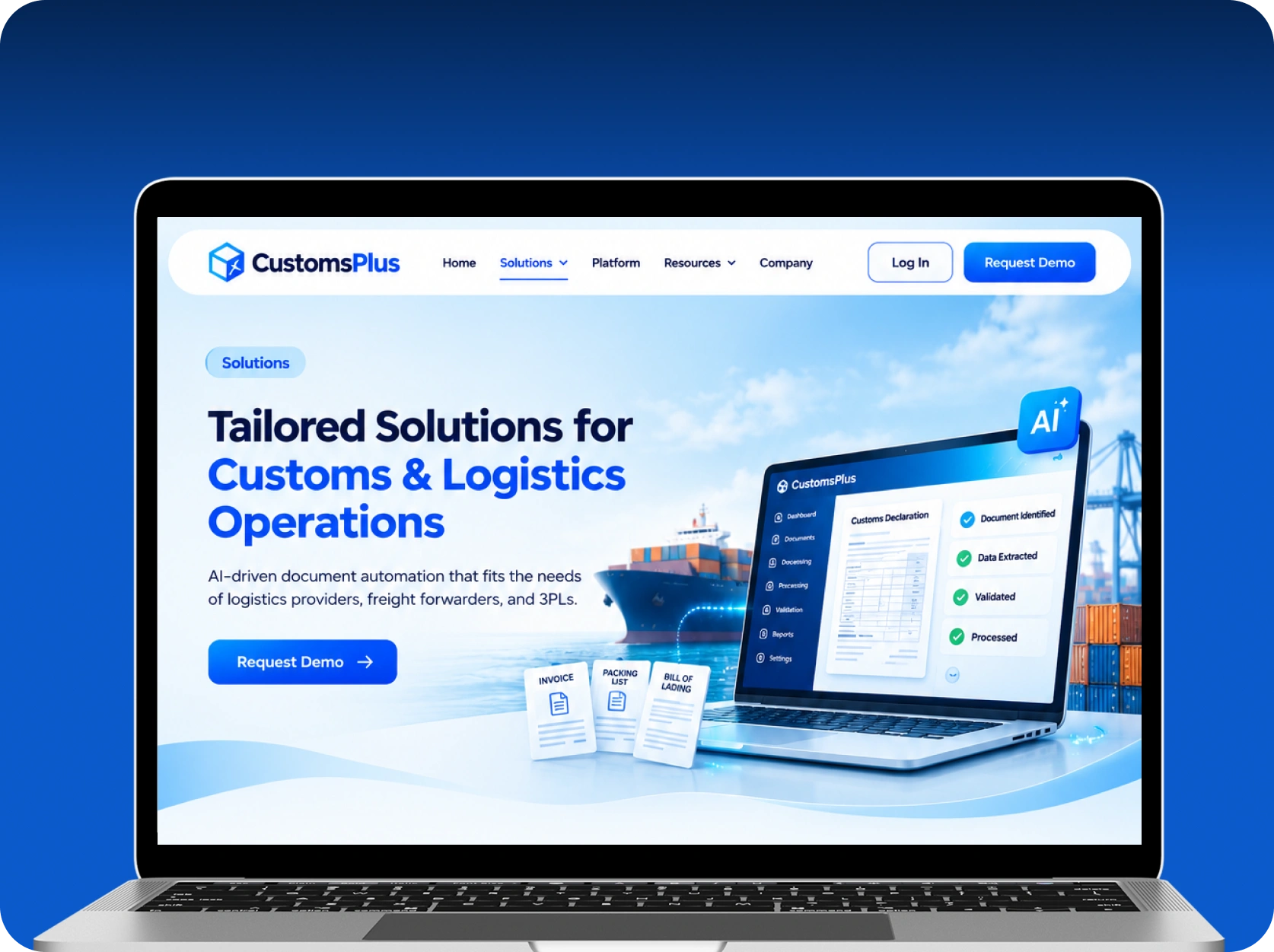
An AI-powered customs document management platform designed to automate the classification, extraction, validation, and processing of international shipping documents. The solution helps logistics companies, freight forwarders, and third-party logistics providers (3PLs) streamline customs documentation workflows by converting unstructured PDF documents into structured, actionable data. The platform leverages artificial intelligence, machine learning, and cloud-based infrastructure to automatically identify document types, extract critical information, validate records, and integrate processed data with existing enterprise systems. By reducing manual data entry and improving document accuracy, the solution enables faster customs processing, greater operational efficiency, and better compliance management.
Introduction
Customs documentation plays a critical role in international trade, where logistics companies process numerous commercial invoices, packing lists, shipping manifests, bills of lading, and customs declarations every day. Traditionally, extracting and entering information from these documents required extensive manual effort, increasing processing time and the possibility of human errors.
CustomsPlus, a provider of automated customs technology, required a scalable solution to simplify document processing and improve operational accuracy. The objective was to automate document classification, extract relevant information, validate data, and connect the processed information with existing business applications.
The platform was developed using AI/ML capabilities and multi-cloud infrastructure, combining Azure Form Recognizer with AWS serverless services. This enabled automated document handling, visual data verification, standardized information processing, and real-time integration through webhooks.
Tech Stack
 Azure Form Recognizer
 AWS Serverless
 Python
 FastAPI
 ReactJS
 DynamoDB
Key Features

AI-Powered Document Classification
Automatically identifies and categorizes different types of customs and shipping documents, including commercial invoices, packing lists, shipping manifests, and bills of lading. AI-driven document classification eliminates the need for manual sorting and ensures that incoming documents are directed through the appropriate processing workflows.
Automated Data Extraction
Uses intelligent document processing and Azure Form Recognizer to extract important information from unstructured PDF documents. The system captures essential details such as invoice numbers, dates, item descriptions, and other relevant shipment information, converting them into structured data for further processing.
PDF Text Highlighting & Data Verification
Provides visual transparency by highlighting extracted information directly within the original PDF documents. Users can quickly identify the source of extracted values, verify their accuracy, and review important information without repeatedly searching through lengthy documents.
Intelligent Data Labeling & Standardization
Organizes extracted information through automated labeling and document-specific data mapping. The platform dynamically transforms different document formats into standardized data structures, improving consistency and reducing the manual effort required to prepare information for downstream business applications.
Real-Time Webhook Integration
Connects the document processing platform with external enterprise applications through webhook-based integration. Once information is extracted, validated, and standardized, the system automatically transmits structured data to connected ERPs, CRMs, and warehouse management systems, reducing manual data transfer and processing delays.
Adaptive AI Model Training
Supports evolving document formats and changing information requirements through continuous model training using diverse PDF samples. Azure Form Recognizer enables the document processing solution to adapt to different layouts and improve its ability to identify and extract relevant information from incoming documents.
Scalable Multi-Cloud Document Processing
Combines Azure AI capabilities with AWS serverless infrastructure to support automated document processing at scale. Amazon S3 manages document storage, SQS supports asynchronous processing, and AWS Lambda executes processing workflows. DynamoDB maintains structured application data, while FastAPI and ReactJS support backend services and the user interface.
Challenges
-
Time-Consuming Manual Document Processing
Logistics employees were required to manually review commercial invoices, packing lists, and bills of lading, extracting relevant information and entering it into multiple operational systems. This repetitive process consumed approximately 50% of their working time, limiting productivity and increasing operational overhead.
-
Data Inaccuracy & Compliance Risks
Processing thousands of shipping documents introduced the possibility of incorrect entries, calculation mistakes, invoice mismatches, and inconsistent information. Without automated validation and standardized data structures, maintaining accuracy and meeting customs documentation requirements became increasingly difficult.
-
Disconnected Enterprise Systems
Extracting information from documents was only one part of the workflow. Transferring validated information into ERPs, CRMs, and warehouse management systems introduced additional complexity. Inconsistent document formats and unstructured data required further manual corrections before information could be integrated successfully.
-
Changing Document Formats & Processing Requirements
Different logistics providers and business partners used varying document layouts and formats. Static extraction methods struggled to accommodate these changes, creating the need for an adaptable document processing solution capable of handling new document structures and evolving data requirements.
Our Approach
-
AI-Based Document Classification & Processing
Implemented Azure Form Recognizer to automatically identify and categorize incoming customs and logistics documents. The solution was designed to recognize different document types and route them through appropriate processing workflows, reducing manual document sorting and improving operational consistency.
-
Intelligent Information Extraction
Developed automated data extraction capabilities using AI/ML techniques to capture important information from unstructured PDF documents. Key fields, including invoice numbers, dates, and item-specific details, were converted into structured records to minimize manual data entry and improve processing efficiency.
-
Visual Verification & Data Transparency
Introduced PDF text highlighting and automated data labeling to improve the transparency of extracted information. These capabilities allowed users to trace extracted values back to their original document locations, simplifying verification and reducing repetitive document reviews.
-
Automated Data Transformation & Standardization
Developed dynamic data transformation workflows to normalize information across different document types and layouts. The system standardized extracted fields into consistent formats, helping minimize data inconsistencies and making the information suitable for integration with enterprise applications.
-
Cloud-Based Workflow Automation & Integration
Leveraged AWS S3, SQS, and Lambda to build scalable document processing workflows. Integrated webhook functionality to automatically transmit validated and standardized information to external enterprise systems, enabling faster data exchange and reducing manual transfer requirements.
-
Continuous AI Model Improvement
Incorporated model training capabilities using diverse PDF samples through Azure Form Recognizer. This approach helped the platform adapt to changing document structures, improve extraction performance, and maintain long-term flexibility as logistics documentation requirements evolved.
Results & Impact
The AI-powered customs document management platform significantly improved the efficiency of logistics documentation workflows by automating document classification, information extraction, data validation, and enterprise system integration.
By combining Azure AI services with AWS serverless infrastructure, the solution reduced dependency on repetitive manual processes, improved information consistency, and enabled faster document processing across customs and logistics operations.

Let’s Build Something
Exceptional
Innovify transforms ideas into impactful products, blending design and engineering from concept to scale. Through onshore and nearshore collaboration, we deliver speed, clarity, and top talent without compromise.
Visit Portfolio
See More Case Studies
Our clients speak for us! Our Clutch-verified reviews reflect our dedication to delivering top-notch solutions.