All Case Study

EmberGrid Safety: Intelligent Building Protection & Connected Device Management
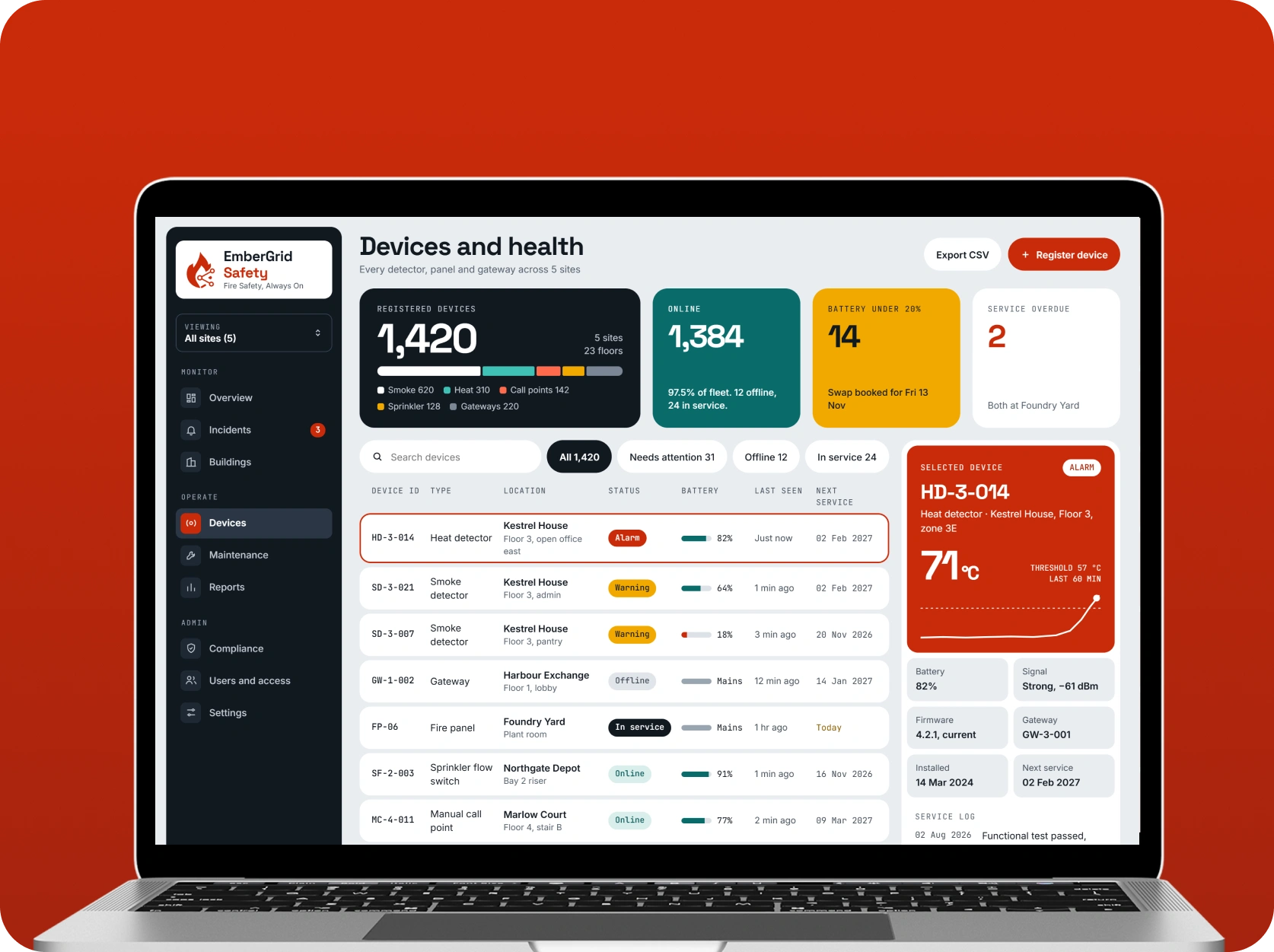
An intelligent IoT-based fire safety monitoring platform designed to strengthen building protection through connected sensor networks, centralized device management, real-time safety insights, and automated incident workflows. The solution provides a unified environment for monitoring fire detection infrastructure across multiple locations, identifying abnormal device conditions, coordinating maintenance activities, and improving visibility into building safety operations.
Introduction
Managing fire safety infrastructure across commercial buildings, industrial facilities, and large residential properties requires continuous monitoring, reliable device connectivity, and timely maintenance. Traditional safety management processes can make it difficult for facility teams to maintain visibility into distributed detection systems, identify equipment issues, and coordinate responses when potential hazards arise.
The objective was to conceptualize EmberGrid Safety, a connected fire safety management platform that brings IoT-enabled detection devices, building monitoring, equipment health insights, and incident management into a centralized ecosystem. The solution was designed to support real-time communication between connected devices and the management platform while providing administrators and facility teams with actionable information about system conditions. A scalable architecture was also required to support multiple buildings, different device categories, and growing IoT infrastructure.
Tech Stack
 React.js
 React Native
 Node.js
 MQTT
 AWS IoT Core
 PostgreSQL
Key Features

Centralized Fire Safety Device Management
Developed a centralized device management concept that allows facility administrators to organize connected fire detection equipment across multiple buildings and operational locations. The platform provides a structured device inventory with information such as device identification, installation location, connectivity status, and operational condition. This centralized approach helps facility teams maintain better visibility into distributed safety infrastructure and organize equipment management activities.
Real-Time Fire Detection & Environmental Monitoring
Designed an IoT monitoring framework that collects information from connected detection devices and environmental sensors. The system can process incoming device events and display relevant safety conditions through a centralized dashboard. Configurable monitoring rules provide a foundation for identifying abnormal conditions, potential fire-related events, and changes in connected device status, helping facility teams access important information more efficiently.
Intelligent Device Health & Performance Analytics
Introduced device health monitoring capabilities to organize operational information such as connectivity, battery condition, sensor status, and communication activity. Historical device information and performance trends can help administrators identify equipment requiring inspection or maintenance. This approach creates greater visibility into the condition of connected safety infrastructure and supports more proactive equipment management.
Automated Incident Management & Alert Notifications
Designed an incident management workflow that organizes incoming safety events and communicates relevant notifications to authorized personnel. Alert classification and notification rules can help distinguish between different event types, such as potential fire detection, device connectivity problems, and maintenance requirements. Centralized incident records also provide a structured way to review reported events and track their resolution.
Predictive Maintenance & Service Scheduling
Created a maintenance management framework that organizes device inspection schedules, service requirements, and equipment-related issues. Historical performance information and device health indicators can support the identification of equipment requiring attention. Facility teams can use structured maintenance records to coordinate inspections, document service activities, and maintain better oversight of safety equipment.
Multi-Location Administration & Reporting Dashboard
Designed an administrative dashboard that provides a consolidated view of fire safety infrastructure across multiple buildings and locations. Role-based access allows different stakeholders to access relevant operational information according to their responsibilities. Reporting capabilities can organize device status, incident history, maintenance activities, and operational trends to support better facility-level decision-making.
Challenges
-
Distributed Device Visibility & Management
Managing fire detection equipment across multiple buildings and locations can create visibility gaps for facility administrators. Maintaining a centralized view of connected devices, installation locations, connectivity, and operational status required a structured IoT device management approach.
-
Reliable IoT Communication & Data Processing
Connected safety devices may operate across different connectivity environments and communication protocols. Establishing reliable data transmission and processing workflows was essential for collecting device information and presenting relevant updates within the management platform.
-
Timely Detection & Incident Communication
Potential safety events require clear information and timely communication to relevant personnel. Organizing incoming device events, distinguishing between different alert categories, and establishing notification workflows required careful consideration of event processing and incident management.
-
Equipment Health & Maintenance Coordination
Without structured equipment monitoring, facility teams may find it difficult to identify devices requiring inspection or service. The platform needed to organize device health information, maintenance schedules, and historical service records to support proactive equipment management.
-
Scalable Architecture & Secure Access
Supporting multiple buildings, connected devices, administrators, and facility teams required a flexible technical foundation. The architecture needed to accommodate increasing device volumes, secure communication, role-based access, and integration with existing building management systems.
Our Approach
-
IoT Architecture & Device Connectivity Planning
Established a modular IoT architecture to connect distributed fire detection devices with a centralized management platform. Evaluated communication requirements involving MQTT, BLE, and Wi-Fi to support different device connectivity scenarios. Defined device registration, data transmission, and monitoring workflows to establish a structured foundation for connected safety operations.
-
Real-Time Data Processing & Backend Development
Focused on backend services using Node.js and Python to organize incoming device information, process monitoring events, and manage application workflows. AWS IoT Core was selected as the proposed IoT connectivity layer, while MQTT-based messaging and WebSockets provide a foundation for real-time information exchange between connected systems and the management interface.
-
Centralized Dashboard & Mobile Application Development
Designed an intuitive web dashboard using React.js and TypeScript, alongside a React Native mobile application concept for authorized facility personnel. Organized the interfaces around device inventory, building-level monitoring, safety alerts, incident records, and maintenance activities to simplify access to relevant operational information.
-
Device Analytics & Automated Notification Workflows
Planned device health monitoring and event management capabilities to organize operational information and identify conditions requiring attention. Integrated notification workflows using Firebase Cloud Messaging and AWS SNS to support communication with authorized users. Structured reporting and historical records provide a foundation for analyzing device performance and maintenance trends.
-
Cloud Infrastructure, Security & Quality Assurance
Selected AWS infrastructure, Docker, and Nginx to support scalable application deployment and service management. Incorporated authentication and role-based access considerations using AWS Cognito and JWT. Emphasized connectivity validation, device communication testing, API verification, notification testing, and performance assessments to support reliable platform operations.
Results & Impact
EmberGrid Safety establishes a centralized foundation for managing connected safety infrastructure across multiple buildings and operational locations. By integrating device connectivity, real-time monitoring, equipment health insights, incident management, and maintenance coordination, the solution creates a more organized approach to building safety operations.
The proposed architecture connects IoT devices with web and mobile management experiences, providing facility administrators with better visibility into device conditions and reported safety events. Centralized reporting and structured maintenance workflows also create opportunities to improve equipment oversight and coordinate operational activities more effectively.
Key expected business benefits include:
-
Improved Safety Visibility
Provides centralized monitoring of connected fire detection infrastructure across multiple locations.
-
Faster Incident Awareness
Supports timely communication of device events and potential safety issues through automated notification workflows.
-
Proactive Equipment Management
Organizes device health information and maintenance records to support timely inspections and servicing.
-
Centralized Facility Operations
Simplifies the management of connected devices, building information, and safety-related activities through a unified platform.
-
Data-Driven Decision-Making
Provides structured reporting and historical information to help facility teams review operational trends and equipment conditions.
-
Scalable IoT Infrastructure
Establishes a flexible technical foundation for additional connected devices, building integrations, and future safety management capabilities.

Let’s Build Something
Exceptional
Innovify transforms ideas into impactful products, blending design and engineering from concept to scale. Through onshore and nearshore collaboration, we deliver speed, clarity, and top talent without compromise.
Visit Portfolio
See More Case Studies
Our clients speak for us! Our Clutch-verified reviews reflect our dedication to delivering top-notch solutions.